

Texas has received requests to connect more than 474 gigawatts of new load to its electricity grid.
That is more than five times the state’s record peak demand. Data centres account for approximately 90% of the requested capacity.
The number is extraordinary.
It is also almost certainly not a forecast of what will be built.
In August 2026, the Texas governor directed the Public Utility Commission of Texas and the Electric Reliability Council of Texas to audit data-centre projects before allowing them to advance through the grid-connection process. Applicants must provide information about ownership, power requirements, generation plans, water use, cooling systems, tax incentives and their effects on surrounding communities. Projects that fail to complete the audit must be denied connection. Office of the Texas Governor: Data-centre audit
The decision does not mean the AI infrastructure boom is imaginary.
It means the system designed to measure that boom is producing a contaminated signal.
A connection request may represent a financed facility with land, customers and equipment already secured. It may also represent a developer examining several possible locations, an early-stage proposal without a committed customer or an attempt to reserve capacity before competitors can obtain it.
The queue places those projects beside one another and expresses both in megawatts.
Once that number enters forecasts, investor presentations, infrastructure plans and political debate, an application begins to resemble demand.
But they are not the same thing.
A forecast is not demand until someone must pay for being wrong.
The demand is real
The excess inside connection queues should not be confused with an absence of underlying growth.
The US Energy Information Administration expects electricity sales to reach a record 4,135 billion kilowatt-hours in 2026 and rise again to 4,211 billion in 2027. It identifies data-centre development and manufacturing as major drivers of the increase. The West South Central region, which includes Texas, is expected to account for the largest regional share of national electricity-sales growth despite the pause on new Texas connections. US Energy Information Administration: September 2026 outlook
Existing data centres are consuming more power. New facilities are being financed and constructed. Utilities are signing agreements with large customers, while equipment manufacturers are expanding factories to meet orders for transformers, generators and cooling systems.
The strategic mistake would be to move from that evidence to the assumption that every requested megawatt is equally probable.
Real growth and inflated pipelines can exist at the same time.
Indeed, rapid growth makes inflation more likely. When future capacity becomes valuable, securing a position in the queue becomes valuable even before a project is ready.
A queue can become a market for options
A developer deciding where to build a data centre may approach several utilities.
It may examine multiple sites within the same region. The final choice can depend on land acquisition, fibre access, tax incentives, environmental approvals, financing, customer demand and the delivery schedule for computing equipment.
Submitting several connection requests preserves flexibility while those questions remain unresolved.
From the developer’s perspective, this can be rational. The cost of applying may be small compared with the value of obtaining access to scarce power. Withdrawing later may carry little consequence.
From the system’s perspective, however, each request appears as additional demand.
One facility can therefore create several claims on future infrastructure even though only one location will eventually be selected. Other requests may be contingent on customers that are themselves considering several developers. The same underlying demand can be represented repeatedly across companies, sites and regions.
The queue does not merely overstate the total.
It can distort where demand appears to exist.
Utilities may accelerate transmission projects, acquire land, order equipment or seek approval for new generation based on capacity that never materializes. Communities may make planning decisions around developments that remain speculative. Suppliers may expand production in response to a market pipeline whose conversion rate is unknown.
A cheap application gives the applicant valuable optionality.
Someone else carries much of the cost of interpreting it as a commitment.
Texas is moving from applications to evidence
ERCOT was already developing a more structured approach before the statewide audit.
Its Batch Zero process brings large-load projects of 75 megawatts or more into a common study and requires applicants, transmission providers and distribution providers to submit standardized evidence and attestations. ERCOT’s verification materials, updated as recently as September 2026, require authorized representatives to stand behind the information provided. ERCOT: Large Load Integration
The August audit extends that logic.
A place in the process is no longer supported by a power request alone. The applicant must show more of the complete project.
Texas reinforced that expectation on September 14 when the governor directed the Texas Water Development Board to penalize major users, including data centres, that fail to comply with legally required water-use reporting.
The state cannot plan future water supply without reliable information about existing and anticipated consumption. Data centres that fail to submit the required survey can face legal action and become ineligible for certain water permits. The board must now coordinate with ERCOT so water information becomes part of the broader data-centre audit. Office of the Texas Governor: Water-reporting enforcement
This is an important development.
The credibility of a data-centre project cannot be assessed through its requested electricity capacity alone. A facility also needs water or an alternative cooling design, land, permits, network access, equipment, construction capacity and capital.
If those inputs are missing, the requested megawatts describe an ambition rather than an executable project.
Verification improves the signal by forcing the proposal to become internally consistent.
Bad demand signals create opposite risks
The obvious danger of an inflated forecast is overinvestment.
A utility may construct infrastructure for customers that never arrive. If contracts and tariffs do not allocate that risk correctly, existing households and businesses may ultimately pay for underused assets.
But dismissing the entire pipeline creates the opposite danger.
If planners assume most proposed demand is speculative and fail to prepare, credible projects may arrive faster than new generation and transmission can be built. Reliability deteriorates, connection times lengthen and economically valuable projects move elsewhere.
Pennsylvania illustrates the seriousness of that second risk.
On September 14, the Pennsylvania Public Utility Commission released an independent analysis finding that, under its reference scenario and current PJM load forecasts, the regional grid would fail to meet its reliability-planning standard from 2027 through 2030. The modeled reliability risk in 2030 was nearly six times PJM’s standard. Pennsylvania PUC: Resource-adequacy analysis
The conclusion should not be that the forecast is necessarily correct or incorrect.
It is that forecast quality has become economically consequential.
Pennsylvania has introduced an additional review of utility forecasts submitted to PJM because data-centre proposals increasingly influence expected demand. It has also established a model tariff for loads above 50 megawatts, including deposits, collateral and other financial assurances intended to cover the infrastructure costs created by projects that fail to proceed or consume less power than projected. Pennsylvania PUC: Large-load tariff framework
The objective is not simply to reduce the queue.
It is to make the queue more informative.
Commitment creates information
Britain is pursuing the most direct version of this principle.
Ofgem has proposed a commitment fee for data-centre developers seeking grid connections. Contracted demand on the British system had increased from 41 gigawatts in November 2024 to 125 gigawatts by June 2025, with data centres accounting for at least 80 gigawatts.
Under the proposal, developers would provide financial security worth approximately 2.5% to 7.5% of average project cost. The money would be returned when the facility is energized but forfeited if the applicant exits the queue early. Projects would also need to meet development milestones to retain their position. Reuters: Ofgem’s data-centre commitment-fee proposal
The fee is not valuable merely because it raises the cost of applying.
It produces information.
A developer willing to reserve hundreds of millions of pounds is communicating something different from one willing to complete a form. The financial commitment does not guarantee that the project will succeed, but it makes casual reservation and extensive duplication more expensive.
That allows the queue to begin separating exploration from execution.
The same principle appears in deposits, take-or-pay contracts, minimum-demand charges, early-termination payments and requirements that large customers fund the upgrades needed to serve them.
Each mechanism asks the applicant to absorb some consequence if its forecast proves wrong.
Without that exposure, the rational request is often the largest capacity the applicant might conceivably need.
With exposure, the rational request moves closer to what the applicant expects to use.
Not every commitment proves the same thing
Financial security is powerful, but no single requirement can establish whether a project is ready.
A credible assessment needs several forms of commitment.
Ownership disclosure establishes who is responsible for the request and helps identify affiliated or overlapping applications.
Site control shows that the project is attached to a real location.
Permits and water plans indicate whether the facility can operate within its physical environment.
Equipment orders and construction agreements demonstrate movement beyond concept design.
Financing evidence shows that the applicant can fund the project.
Customer contracts help distinguish capacity built for identified demand from capacity built in the hope that demand will arrive.
Deposits and collateral protect the infrastructure provider if the project fails.
Minimum-demand commitments indicate how much electricity the customer is prepared to pay for after connection.
Milestones reveal whether the project continues progressing over time.
None of these proves the final level of usage. Together, they provide a much stronger signal than requested capacity alone.
The design also matters.
If financial requirements are too low, large developers may treat them as the cost of retaining an option. If they are too high or imposed too early, smaller but credible projects may be excluded while well-capitalized companies continue reserving multiple sites.
Commitment mechanisms therefore need to rise with the maturity of the project.
Early exploration can remain inexpensive, but it should not receive the same standing as a project that has secured land, capital, equipment and customers.
Infrastructure planning needs a conversion funnel
Businesses routinely distinguish between a lead, a qualified opportunity, a signed contract and recognized revenue.
Infrastructure demand should be treated with the same discipline.
A useful data-centre pipeline would distinguish among:
- Capacity requested.
- Capacity supported by a viable site and identified owner.
- Capacity that has passed technical and resource verification.
- Capacity backed by financial security.
- Capacity under construction.
- Capacity approved for energization.
- Capacity actually energized.
- Capacity reaching sustained utilization.
This structure does not eliminate uncertainty.
It makes the uncertainty visible.
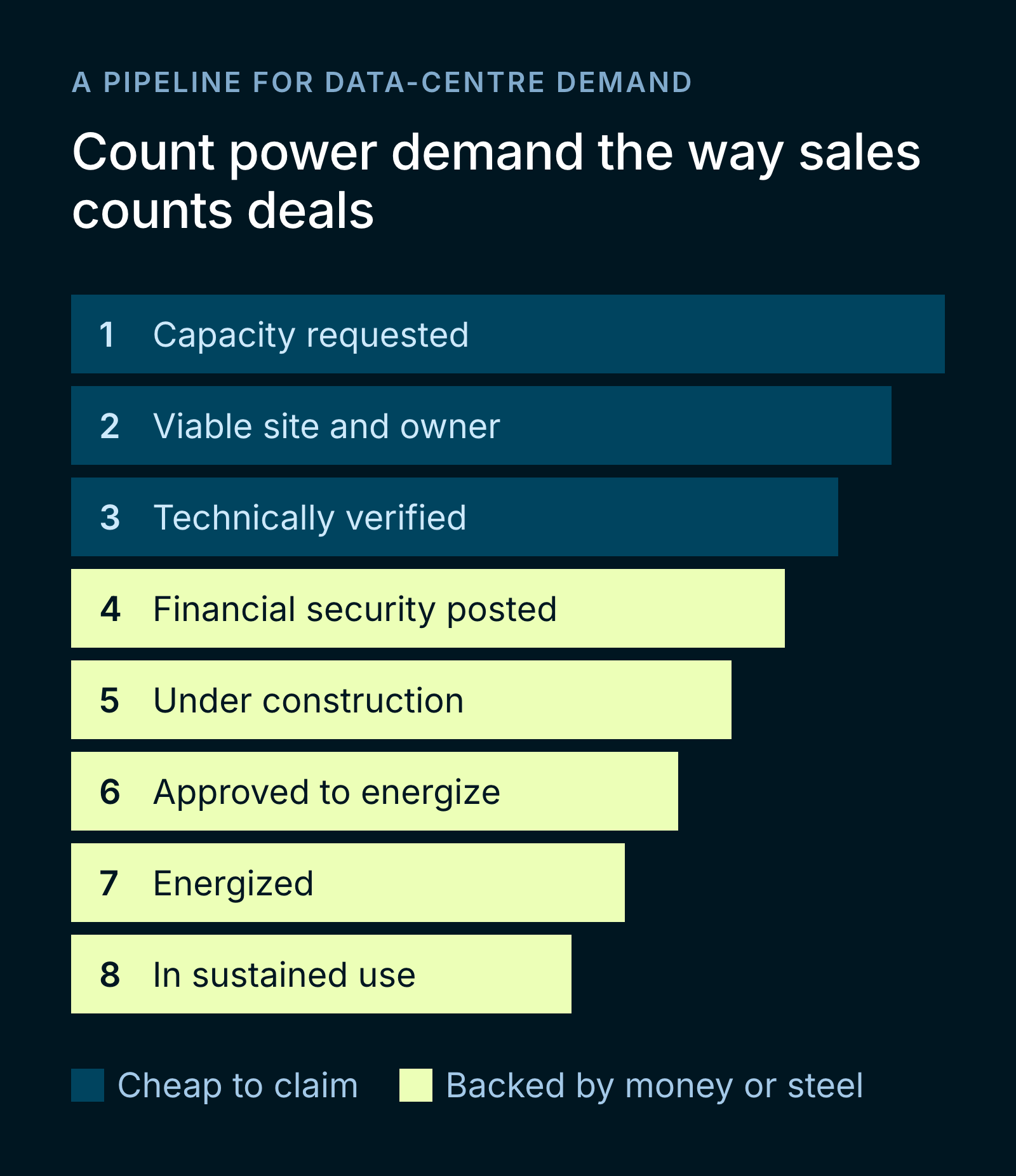
Instead of announcing that 474 gigawatts of demand exists, a planner could state how much capacity sits at each stage and apply different probability assumptions to each category.
A requested megawatt might receive a very low weighting. A financially secured project with construction underway would receive a much higher one. Actual energized load would remain separate from both.
Conversion rates could then be measured over time.
Which developers complete their projects? How long does each stage take? How frequently are requested capacities reduced? How much power do facilities consume during their first three years? Which evidence most strongly predicts completion?
The queue would become a learning system rather than a growing total.
The market should price optionality explicitly
There is nothing inherently wrong with a company preserving strategic options.
The problem arises when the cost of those options is transferred to the owner of a scarce resource.
If a developer wants the right to access future grid capacity while it evaluates several locations, that right has economic value. It should be treated as an option and priced accordingly.
A refundable deposit is one approach. A recurring reservation charge is another. The price could increase as the requested connection date approaches or as the system invests in project-specific infrastructure.
Applicants could retain flexibility, but keeping a place in the queue would no longer be free.
This changes behaviour without requiring regulators to decide which business plans will succeed.
The applicant makes that decision through the amount of capital it is prepared to put at risk.
Serious developers may benefit from such a system. Removing weak and duplicated requests can shorten study times, improve equipment planning and allow credible projects to reach capacity sooner.
The purpose of a commitment mechanism is therefore not to punish demand.
It is to reveal it.
The same problem appears far beyond electricity
Data-centre queues are an unusually visible example of a broader business problem.
Organizations frequently treat expressions of interest as if they were demand.
A customer says it would use a feature, and the product roadmap changes.
A potential partner signs a non-binding letter, and the expected revenue enters a forecast.
Users join a waiting list, and the company interprets registrations as willingness to pay.
A sales pipeline grows, even though few opportunities have completed security reviews, allocated budgets or agreed implementation dates.
The error is the same.
When saying yes is inexpensive, the response measures interest with very little precision.
A stronger demand signal requires a commitment appropriate to the decision being made.
That commitment might be a deposit, a paid pilot, access to operational data, an integration effort, a minimum purchase, a named implementation team or a contractual deadline.
The best evidence is not always money. But it must involve something the customer would not provide casually.
Forecasts should be weighted by consequences
The AI infrastructure boom will continue generating large numbers.
Some will describe real consumption. Some will describe funded construction. Others will describe possible projects competing for position in a constrained system.
Treating them as interchangeable produces weak strategy.
For grid operators, the answer is verification, milestone-based queues and contracts that allocate the cost of error.
For utilities, it is distinguishing requested load from probable load and probable load from committed revenue.
For suppliers, it is examining whether customer pipelines are supported by sites, permits, financing and construction schedules before expanding capacity.
For investors, it is looking beyond announced megawatts to determine who has placed capital at risk and which projects have become difficult to abandon.
For product companies, the same discipline applies to customer demand. Interest should not be allowed to impersonate adoption.
At BraidNest, we view commitment as part of product and market validation. A strong signal is not simply a customer describing what it wants. It is a customer accepting some cost, effort or loss of flexibility in order to obtain it.
Texas’s 474-gigawatt queue is valuable precisely because it reveals the limit of headline demand.
The AI boom is real.
But the quality of decisions built around it will depend on whether companies and institutions can distinguish genuine commitments from inexpensive claims on the future.
A forecast becomes useful when being wrong has a price.