
OpenAI calls its new enterprise agents “dots.” They are designed to remain active across evolving projects, connect to tools such as Slack and Microsoft Teams and operate cloud computers on a company’s behalf. The name is intentionally modest. The operating implication is not. Software is moving from answering questions to carrying work forward over time. Reuters: OpenAI’s enterprise agent push
For many companies, the business case appears straightforward. If an agent can handle a large share of routine work, fewer people should be required to operate the process.
That calculation is often made as though automation removes a representative sample of the workload.
It does not.
Agents tend to absorb the repetitive, legible and recoverable cases first. The work that remains is disproportionately ambiguous, emotionally difficult, technically unusual or financially consequential.
The result is not simply a smaller version of the old job.
It is an exception queue.
Automation does not leave an average sample of work
Consider a support operation receiving 1,000 requests.
Seven hundred are routine and take five minutes each. The remaining 300 are complex and take twenty minutes each. Before automation, the operation carries 9,500 minutes of work.
If an agent resolves all 700 routine requests, it has automated 70% of the volume. But it has removed only 3,500 minutes. The 300 cases left behind still require 6,000 minutes of human work.
The queue has fallen by 70%. The workload has fallen by approximately 37%.
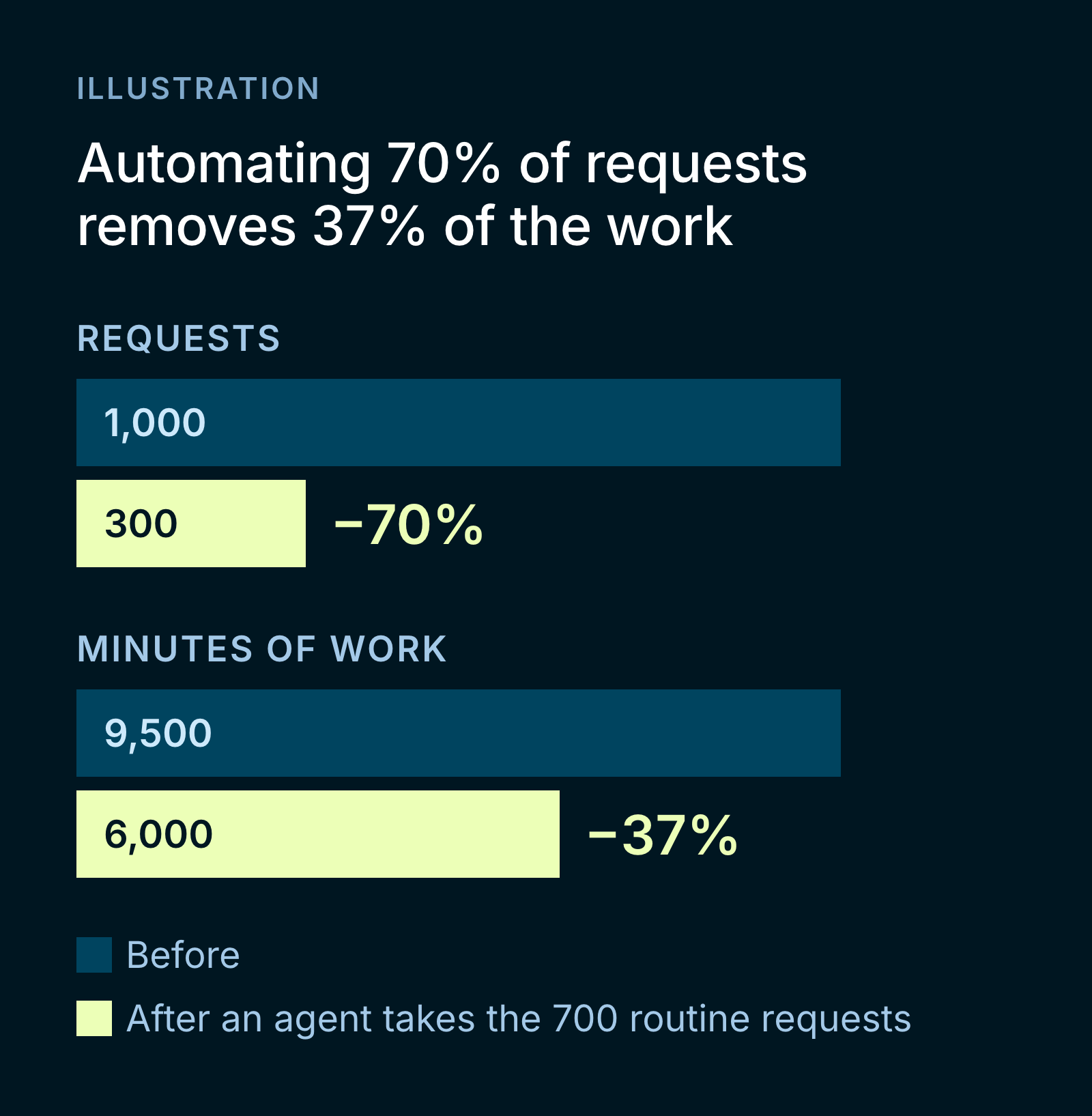
The illustration is simplified, but the underlying effect is common. Easy cases and hard cases do not consume equal time, judgment or emotional energy. A volume-based automation rate can therefore create a much stronger impression of labor reduction than the operating reality supports.
The remaining work may also become slower. Employees no longer move between simple and difficult cases. They spend a larger share of the day reconstructing failed attempts, resolving contradictory information and handling customers who are already frustrated by the time the case reaches them.
Automation changes the distribution of work, not simply its volume.
Assistance and autonomy reshape work differently
The distinction is easier to see when assistance and autonomy are separated.
An assistant helps a person perform the same portfolio of work. It can retrieve information, draft a response or suggest a next step while the employee remains attached to the case.
That model can improve performance without fundamentally changing the mix of work reaching the employee. In a study of 5,179 customer-support agents, access to a generative AI assistant increased productivity by 14% on average and by 34% for novice and lower-skilled workers. The tool helped less-experienced employees apply patterns associated with stronger performers. NBER: Generative AI at Work
Autonomy operates differently.
When an agent completes routine cases without human involvement, it does not make every worker proportionally faster. It changes which cases people see at all.
The employee becomes less of a general operator and more of an exception handler. The work shifts from repetition toward interpretation, recovery and judgment.
That can be a better job. It can also be a more demanding one. The difference depends on whether the organization redesigns the role around the new composition of the queue.
The headcount calculation breaks at the queue
Traditional staffing models often begin with transaction volume, average handling time and available working hours.
Agentic systems disturb every part of that equation.
The remaining queue contains more variable work. One case may take three minutes. Another may occupy a senior employee for an hour and require coordination across several teams. Average handling time becomes less stable precisely because the cases that made the average predictable have been removed.
Arrivals also become more uneven. A policy change, failed integration or model update can generate clusters of similar exceptions at once. Human capacity that looks excessive during ordinary periods can become inadequate when the agent encounters a condition it was not designed to handle.
Research on the economics of human and AI collaboration reaches a related conclusion: near-perfect automation can be disproportionately expensive, while partial automation often remains the practical equilibrium. Complex tasks continue to favor human participation because the cost of covering the final cases rises faster than the value of replacing every person. The Economics of Human and AI Collaboration
The staffing question is therefore not simply how many tasks the agent can complete.
It is how much human capacity the residual workload requires, at what skill level, and with what buffer for volatility.
The old productivity metrics begin to lie
Once people inherit the exceptions, familiar measures can reward the wrong behavior.
Average handling time may rise even while the overall system improves, because employees are receiving harder cases. Cases closed per hour can fall for the same reason. Comparing pre-automation and post-automation performance without adjusting for case mix makes the workforce appear less productive just as it becomes more specialized.
Deflection is equally easy to misread.
A conversation has not created value merely because it did not reach a person. If the customer abandons the process, repeats the request through another channel or returns later with a larger problem, the agent has deferred work rather than resolved it.
The unit of measurement must move from activity to outcome.
For customer service, that may include durable resolution, repeat contact, recovery time and customer effort. For finance operations, it may include exceptions corrected before close, losses avoided and the time required to clear blocked transactions. For internal agents, it may include completed workflows rather than messages sent or tasks initiated.
The organization should still measure what the agent handles. It must also measure the work the agent creates, transfers and fails to finish.
Not every exception belongs in the same queue
The word “exception” can conceal important differences.
Some exceptions are informational. The system lacks a document, cannot reconcile two records or does not know which policy applies.
Some are matters of authority. The correct action is understood, but it requires a person with permission to approve a refund, accept a contractual risk or make a regulated decision.
Others are technical. A tool has failed, an integration has returned an unexpected result or the agent has entered a state from which it cannot recover.
And some are emotional. The customer may understand the answer but need acknowledgment, reassurance or discretion that the automated process has not provided.
These categories require different people and different response times.
A 2026 randomized field experiment by Alibaba researchers found that human intervention improved recovery more reliably for technical escalations than for emotional ones, and that the timing of the intervention mattered. The finding is a useful warning against treating every handoff as equivalent. Agentic AI and Human in the Loop
Sending every failed case into one general queue reproduces the old workflow with a new source of confusion.
Production systems need routing that reflects why the agent stopped. The receiving person should know what happened, what the agent attempted, which information it used and what authority is now required.
The human is not simply the final step. The human is the recovery system.
The human role becomes more demanding
Routine work has always done more than consume time.
It gives employees practice, establishes rhythm and creates lower-stakes moments between difficult cases. It is also where new employees often learn the rules of the operation before taking responsibility for unusual situations.
When agents remove that layer, the remaining role can require more experience while providing fewer opportunities to acquire it.
An employee may spend the day moving from a distressed customer to a policy conflict to an unexplained technical failure. The organization has reduced the number of cases but increased their average cognitive and emotional intensity.
That has implications for hiring, compensation, scheduling and supervision.
Smaller teams may need greater seniority. Break patterns may need to reflect the concentration of difficult interactions. Quality management may need to focus less on script adherence and more on judgment. Training must prepare people for the cases the agent cannot solve, not the routine cases it handles well.
There is also a pipeline problem.
If entry-level work disappears while senior exception-handling remains, the company must determine how future experts will develop. Automation can remove the apprenticeship layer faster than it removes the need for experienced judgment.
The workforce model cannot be derived from the old role after subtracting automated tasks. It has to be designed around the work that remains.
Every exception should change something
An exception queue can become a permanent cost center, or it can become the most valuable source of evidence in the system.
The difference depends on whether the organization captures why cases arrive.
Every transferred case should carry a reason. Was information missing? Did the agent lack authority? Was a rule unclear? Did a customer reject the proposed resolution? Did a tool fail? Did the agent act incorrectly before escalating?
Those reasons should lead somewhere.
Repeated knowledge failures may require better source material. Repeated policy exceptions may reveal that the underlying policy no longer fits actual customer needs. Repeated authority escalations may justify changing the agent’s permissions. Technical failures may expose an unreliable integration. Emotional escalations may suggest that the handoff is occurring too late.
Research on hybrid service queues has shown how human operators can do more than clear the backlog: their resolutions can improve the virtual agent and affect future waiting times and customer satisfaction. Efficient Customer Service Combining Human Operators and Virtual Agents
That loop is essential.
Without it, the same exception returns indefinitely and the human team becomes an invisible subsidy to the automation. With it, the queue becomes a record of where the operating model needs to change.
An exception is either a recurring cost or a source of learning. The system determines which one it becomes.
Autonomous systems require exception-first design
Most automation projects are still designed from the successful path outward.
The team identifies the common task, demonstrates that an agent can complete it and then adds a human handoff for everything else.
That sequence treats exception handling as a fallback feature.
For autonomous systems, it is part of the core architecture.
The company must decide what the agent is allowed to attempt, how uncertainty is detected, when authority transfers and what information accompanies the case. It needs to know whether people can stop the agent, reverse its actions and see what changed before they became involved.
It also needs to test the human operation under realistic load.
A recent Reuters investigation into Meta’s internal automation effort described teams considering reductions of up to 60%. Internal data reportedly showed code changes increasing by 220%, while incidents rose by 40% and firefighting by 70%. A second wave of the project was cancelled after concerns about agent productivity and the operational burden surrounding it. Reuters: Meta’s Project OT
The lesson is broader than software engineering.
An agent can increase output while degrading the system that must absorb, verify and recover that output. The exception operation is where those effects become visible.
It should therefore be designed before headcount assumptions are locked in.
The remainder becomes the operating model
The strongest case for agents is not that they eliminate people from a process.
It is that they allow people to spend less time on predictable work and more time on situations where judgment has greater value.
But that benefit is not automatic.
If the residual work is treated as a smaller copy of the old queue, the company may understate labor requirements, overload experienced employees and mistake deflection for resolution. If exceptions are routed without context, human involvement becomes slow and expensive. If corrections disappear after the case is closed, the system does not improve.
At BraidNest, we view the exception layer as part of the product and operating model, not an afterthought to automation.
The work is to define the boundary of the agent’s authority, make failure legible, route each case to the right capability and use the resulting evidence to improve the system around it.
The volume that remains may be smaller.
Its importance is not.
Automation does not eliminate the operating model. It concentrates it in the exceptions.
Developments reviewed through October 6, 2026.