
Revolut did not set out to make its engineers use less AI. It wanted them to stop rationing it.
When the fintech put spending limits on its coding tools, engineers had a reason to save their allowance for difficult programming tasks. Looking through documentation, investigating a bug or pulling together context from Jira and Confluence was harder to justify. Yet that was precisely the work where cheaper, more readily available AI could save time. David Abitbol, AI Engineer NYC
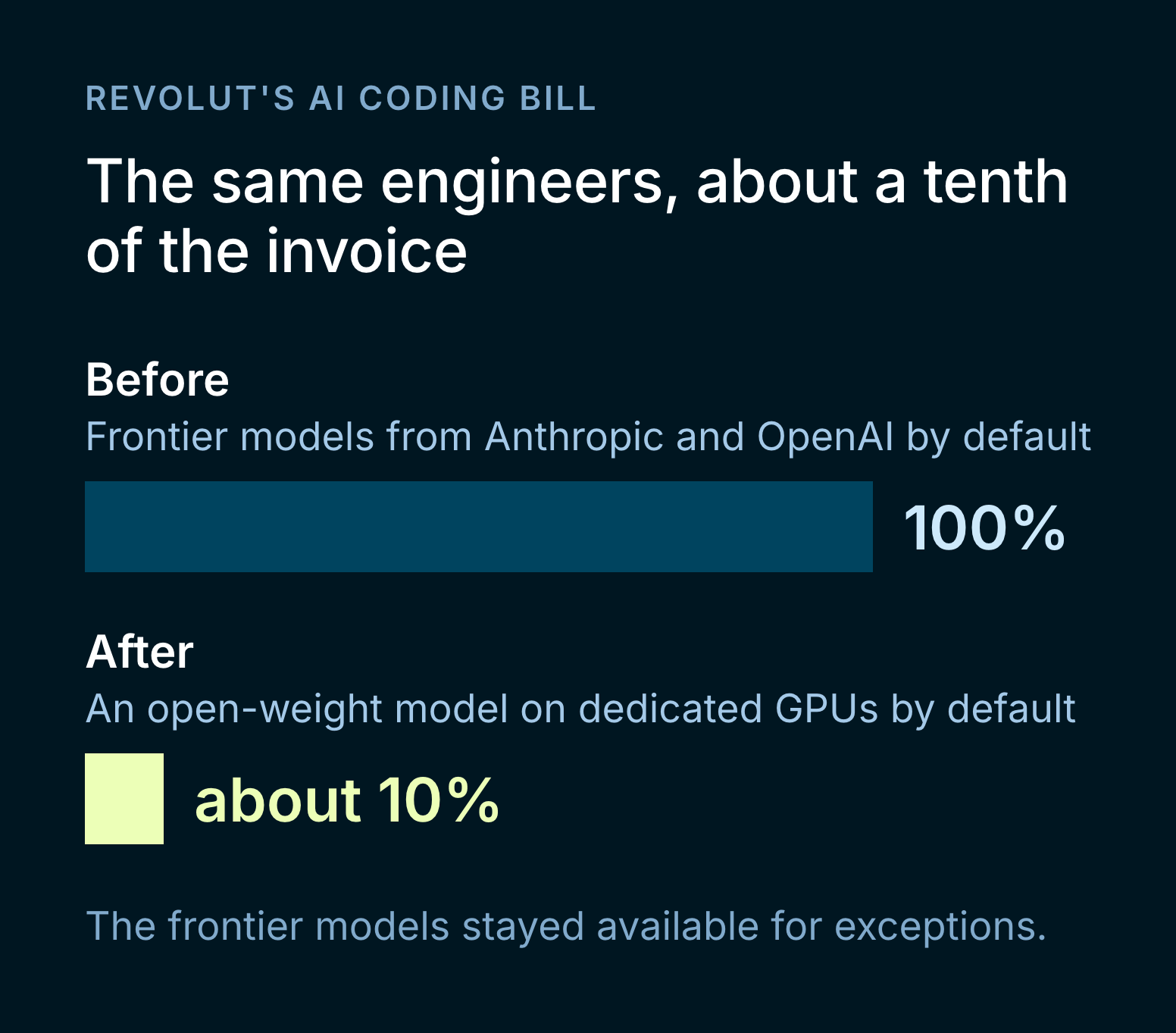
Revolut changed what it bought. It made GLM, an open-weight model family from the Chinese developer Z.ai, the default for much of its engineering work. Instead of using Z.ai’s hosted service, it ran the downloaded weights on dedicated Nvidia GPUs. It kept access to proprietary frontier services, including Anthropic’s Claude Code and OpenAI’s Codex, for exceptions. Image inputs could be routed to a different model. Revolut’s deployment · Z.ai’s GLM releases
David Abitbol, who leads AI operations at Revolut, put its blended serving cost at about $0.30 per million tokens and said the invoice was roughly one-tenth of what it previously spent with Anthropic and OpenAI. That is a reported reduction of about 90% on the comparison he described, not a company-wide cost figure or an audited estimate of total savings. Revolut’s cost disclosure
The precedent is not that every business should copy Revolut’s deployment. It is that a company can use AI more freely while buying considerably less from the suppliers it started with.
The frontier became an exception
Revolut described serving roughly 2,000 engineers on 56 Nvidia B200 GPUs. Simply loading the model was not enough. The team adjusted the serving setup to fit the work engineers actually sent it, cutting the time before a response started from about fourteen seconds to under two on the same hardware. That scale and engineering effort matter when assessing whether another business could reproduce the savings. Revolut’s inference benchmarks
The commercial decision is easier to copy than the infrastructure. An enterprise can ask which work genuinely benefits from the most capable available model and stop paying the premium on everything else. It can do that with a cheaper hosted service, dedicated infrastructure or a mix of the two.
Keeping the frontier available is what makes this credible. A stronger model can still earn its price on a complex migration, an unfamiliar codebase or a problem that a cheaper route repeatedly fails to solve. The change is that those cases have to earn the premium. They no longer set the price for the rest of the work.
The market is counting on more than usage
Suppose two routes produce equally acceptable results on a particular task. If the cheaper one costs a tenth as much per job, a company could run five times as many jobs and still spend half as much. That is an illustration, not a calculation of Revolut’s savings. It shows why rising usage alone cannot tell us how much revenue an AI supplier will capture. The original lab no longer gets paid for the requests that move to a rival’s model and run outside its service.
The implications differ for chipmakers. Revolut moved work away from premium model services, but it still used high-end Nvidia hardware. Cheap inference could create enough new work to lift demand for chips. It could also direct more work towards efficient deployments that get more from existing hardware. This case tells us where the model bill went. It does not tell us how many GPUs the industry will need.
Anthropic’s November 10 IPO filing gives the question financial weight. The company reported $33.2 billion in revenue in the nine months through September, about 79% of it consumption-based. Some customer contracts include minimum spending commitments, so a change in usage does not necessarily hit revenue immediately. Anthropic also disclosed roughly $901 billion in purchase and lease commitments, overwhelmingly related to computing and infrastructure. These span years, some arrangements are conditional or terminable, and the figure is not outstanding debt. The filing explicitly warns that open-weight alternatives could put pressure on prices or take some workloads. Anthropic’s November 10 SEC filing
The two sides of that filing can both be true: rapid growth and genuine demand, alongside a cost base built for years of expansion. The risk is that customers can change what they buy faster than suppliers can change what they have committed to build or lease.
How a correction could spread
On November 5, the S&P 500 fell 4.4% and the Nasdaq Composite fell 5.5% as investors weighed whether the Democratic midterm victories would translate into tighter restrictions on data-centre development. The S&P 500 rallied 2.3% on November 9. Stocks came under pressure again on November 10 after hotter-than-expected inflation data. The market was repricing several risks, not reacting to Revolut. November 5 selloff · November 9 closing data · November 10 market report
The Nvidia story added a separate risk. House committee chairs requested a closed-door briefing on security protocols and CEO Jensen Huang’s reported contacts. On November 8, Nvidia’s board announced an independent inquiry into reports that Huang had been targeted by a foreign intelligence effort. The board said it had no reason at that point to believe national security or company secrets had been compromised. Some lawmakers have since used the reports to press for tighter chip-export oversight. That is a policy risk, not a finding that any breach occurred, and it has no demonstrated connection to Revolut’s use of a Chinese model. House committee letter · Nvidia board statement · Reuters on export oversight
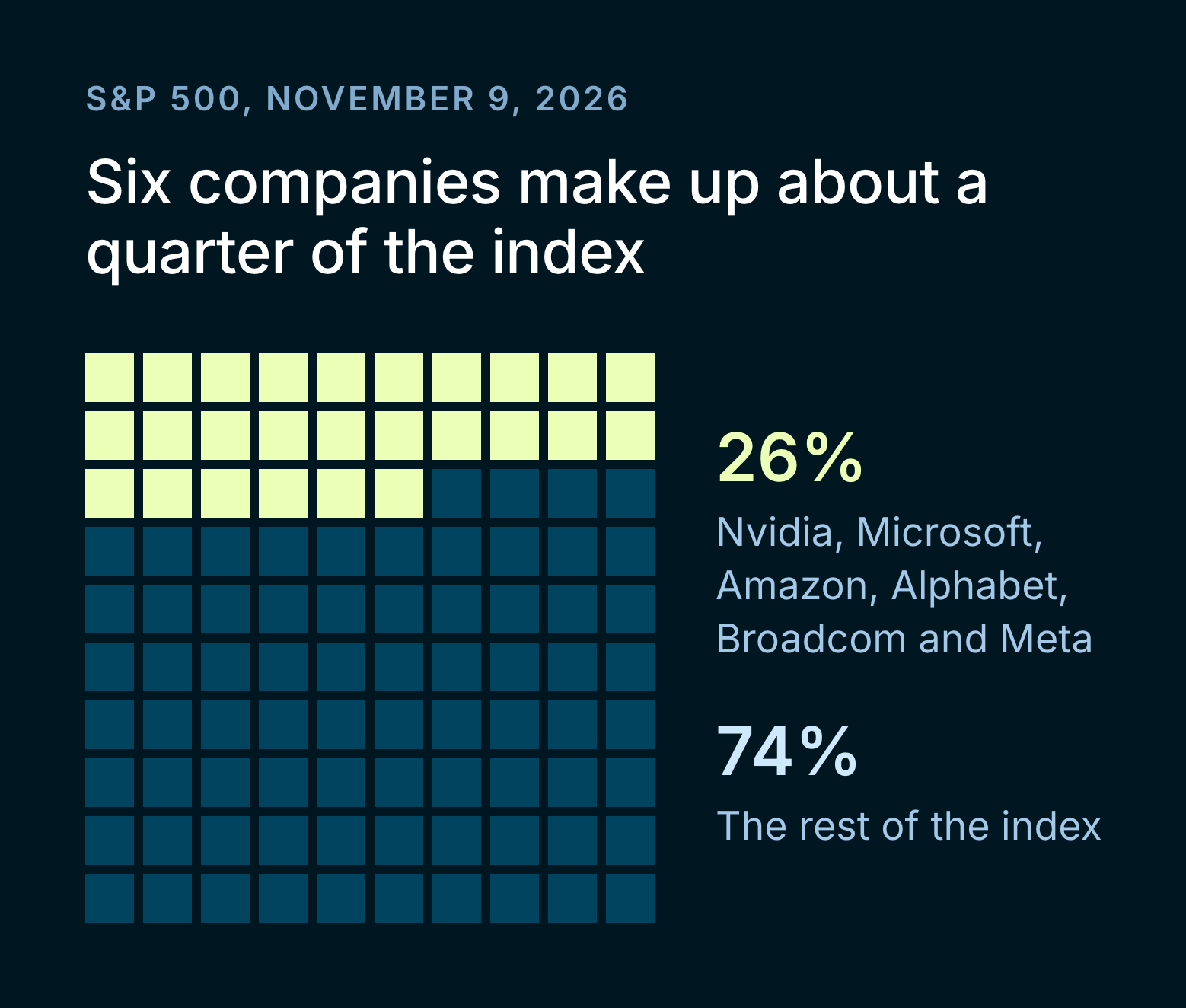
As of November 9, Nvidia, Microsoft, Amazon, Alphabet, Broadcom and Meta accounted for about 26% of the S&P 500 combined, counting both Alphabet share classes. These are different businesses. But an investor holding a broad US index can have substantial exposure to a single spending cycle: the same buildout generates revenue for chip suppliers and consumes capital at the large cloud and technology companies. State Street’s S&P 500 index weights
The real-economy link is spending, not stock prices. The OECD found that investment in data-centre structures and technology equipment helped lift second-quarter US growth. Falling share prices do not subtract from GDP directly. A sustained slowdown in construction, equipment orders and hiring could take away one of the sources of recent growth. OECD Economic Outlook
The IMF has also warned that weaker AI profitability could trigger a correction amplified by leverage and by the way some companies in the sector invest in their own customers. If a customer falters, a supplier can lose both the value of its investment and the future sales it was counting on. Add a broad index with meaningful exposure to the same companies, and there is a plausible route from a sector repricing to a wider selloff. A serious downturn does not require AI to stop working. It requires the returns to come in far enough below expectations. IMF Global Financial Stability Report
What the industry should change
Enterprise buyers should test the alternative before committing to capacity. Start with one high-volume workflow and compare the cheaper route with the incumbent on the same work. For a coding team, measure the cost of a change that passes review, not just the cost of generating a patch. Include retries, reviewer time and the cost of keeping capacity available. Define when a harder case moves to a stronger model and when it needs an engineer instead. Running downloaded weights can give a company more control over where its data goes; it still has to verify the model’s provenance and licence, the host’s data access, and what the coding agent can do.
Frontier labs should make it easier to buy less intelligence when less will do. A lab can offer a cheaper tier, or make its tools useful across several models, rather than asking customers to build their own way around the premium. Where the best model prevents expensive mistakes or finishes work that cheaper ones cannot, the lab has a durable reason to charge more. The test is whether customers keep paying for that difference once they have a credible alternative.
Cloud providers and infrastructure investors should forecast capacity by workload. Work performed, revenue earned and hardware required are three different forecasts. Stress-test what happens if the price of routine inference falls, fewer requests reach the frontier, or existing chips can serve substantially more work. Build in stages against paid utilization, and design capacity that can handle a different mix of models and customers if the original plan changes.
At BraidNest, we would start by making model choice a decision the business can revisit without rebuilding the workflow. That means keeping evaluations, routing rules and operating controls with the product so the team can verify that a cheaper route works before it moves the traffic.
The best test of an AI business may be what happens to it when its customers succeed at making AI cheap.
Developments reviewed through November 10, 2026. This article is strategic commentary, not investment advice.