

The 2026 Stanford AI Index describes a technology advancing at extraordinary speed. Capability is rising, adoption is spreading and investment continues to accelerate.
Yet beneath the headline figures lies a more useful conclusion for businesses: access to advanced AI is no longer the primary constraint.
The harder question is whether organizations can convert that intelligence into dependable, economical systems.
In this perspective piece, we step back from the competition between individual models and focus on what the Index says about implementation. The report dates to April 2026. Several developments since its publication have already reinforced its central findings.
Sources Stanford HAI, 2026 AI Index
Capability is converging at the frontier
Frontier models continue to improve, but the leading systems are also becoming harder to distinguish from one another.
As of March 2026, four major providers were separated by only 25 points on the Arena leaderboard. Across professional evaluations covering tax, mortgage processing, corporate finance and legal reasoning, the top 15 models were separated by as little as three percentage points.
Stanford concludes that this convergence is shifting competition toward cost, reliability and domain-specific performance.
Sources AI Index: Technical performance
This changes the strategic question.
If several providers can deliver broadly comparable intelligence, selecting whichever model happens to lead a general benchmark is not an enduring strategy. The advantage moves into the operating layer around it: how tasks are routed, what context is supplied, how outputs are evaluated and when human judgment enters the process.
The model remains important. It is simply no longer the entire strategy.
Adoption is broad, but integration remains shallow
Organizational AI adoption reached 88% in 2025. Seventy percent of surveyed organizations reported using generative AI in at least one business function.
Yet AI-agent deployment remained in the single digits across almost every function.
Sources AI Index: Economy
That gap may be one of the report’s most commercially significant findings.
Many companies now have access to AI. Employees may use assistants for research, writing, analysis or code. But comparatively few organizations have redesigned complete workflows around the technology.
There is a meaningful difference between helping someone perform an individual task and creating a system that can reliably produce an organizational outcome.
The latter requires process knowledge, integrations, permissions, evaluation, exception handling and accountability. These elements are less visible than the model itself, but they determine whether a promising experiment becomes a durable operating capability.
Access is becoming commonplace. Operational depth is not.
The jagged frontier is an operational problem
Stanford offers a memorable example of AI’s uneven abilities. Gemini Deep Think earned a gold medal at the 2025 International Mathematical Olympiad, yet the best model tested on analog clocks was correct only 50.6% of the time, compared with 90.1% for humans.
AI agents made similarly striking progress. Performance on OSWorld, which measures the ability to complete tasks across computer operating systems, increased from roughly 12% to 66.3%. That is a significant advance, but it still represents failure in approximately one out of every three attempts.
Sources AI Index: Technical performance
This unevenness is sometimes called the jagged frontier of AI. A system may demonstrate exceptional reasoning in one domain while failing at a task that appears far simpler.
For businesses, that is not an academic curiosity. It is an operating constraint.
AI must therefore be evaluated against the work it is expected to perform, not against general claims about intelligence. A model that performs brilliantly on one class of problem may remain unreliable elsewhere in the same workflow.
Testing, monitoring and escalation are part of the solution itself. They cannot be treated as administrative layers to add later.
More output is not the same as completed work
Stanford finds that the largest productivity improvements tend to appear in structured tasks where outputs can be measured easily. Studies cited in the report find gains of approximately 14% to 15% in customer support, 26% in software development and 50% in marketing output.
The gains become less consistent when work requires deeper reasoning, contextual understanding or difficult judgment.
Sources AI Index: Economy
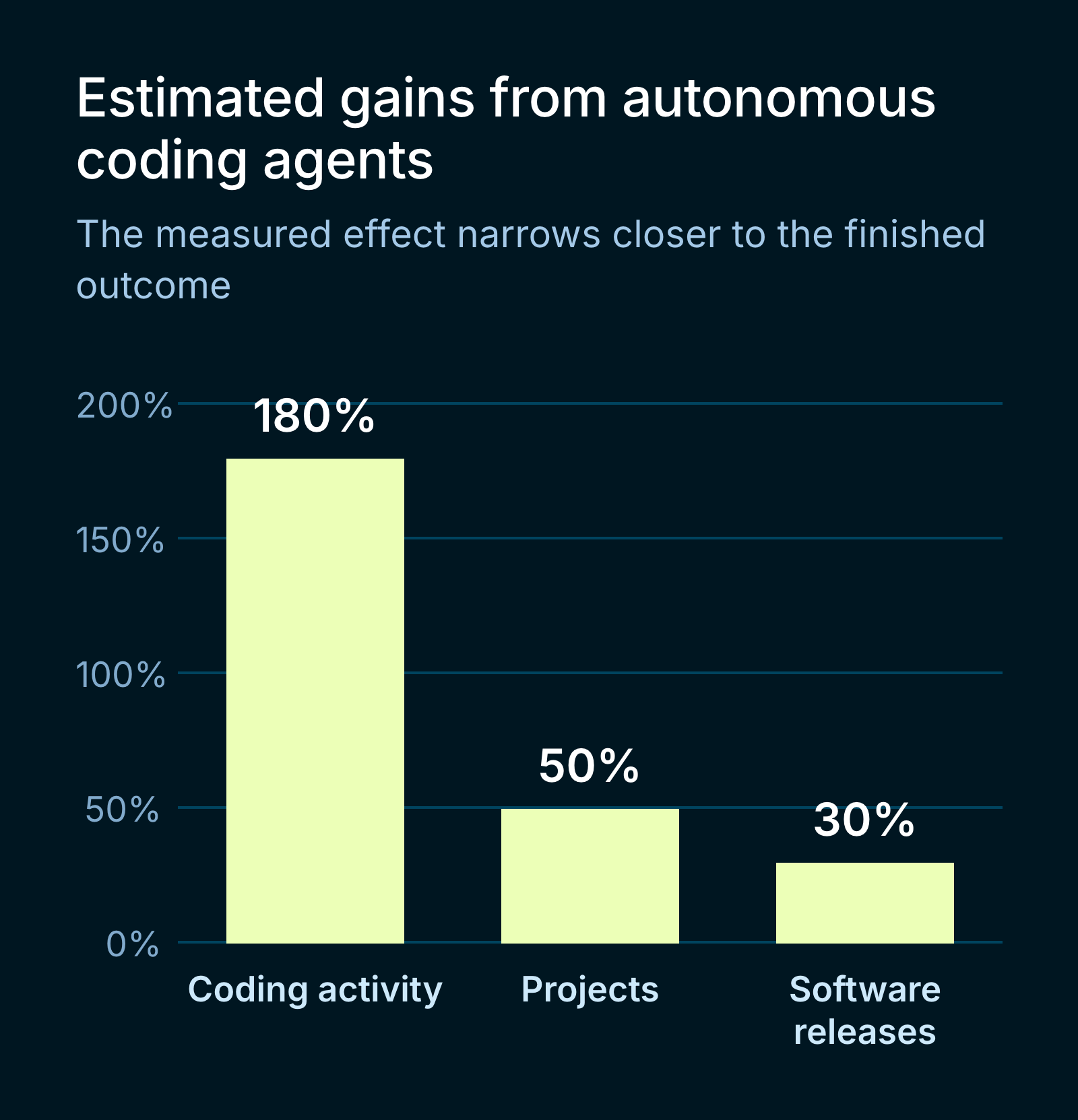
Research published after the Stanford Index makes this distinction even clearer. A May 2026 NBER working paper examined AI coding tools using data from more than 100,000 developers. Autonomous coding agents increased coding activity by 180%, but the effect fell to 50% at the project level and 30% for actual software releases.
Sources NBER Working Paper 35275
The lesson extends well beyond software.
AI can make one step substantially faster without producing a comparable improvement in the complete process. If reviews, approvals, customer decisions or downstream handoffs remain unchanged, additional output may simply reach the next bottleneck sooner.
Meaningful implementation therefore begins with the outcome. Where does the work actually slow down? Which steps contribute value? Which exist because information or responsibility cannot move efficiently?
Those questions often matter more than how quickly a model produces its first response.
Technical feasibility does not guarantee adoption
A second NBER paper published in May found only a weak relationship between jobs considered highly exposed to AI and workers’ actual use of the technology.
The researchers concluded that adoption depends on whether AI has a practical economic advantage for the specific task. Technical capability must be weighed against user effort, worker productivity and the cost of operating the system.
Sources NBER Working Paper 35271
This helps explain why apparently automatable processes often remain unchanged.
A technically impressive solution can still fail if it requires extensive supervision, creates costly exceptions or saves time in an area that was never constraining the business. Conversely, automating an ordinary administrative step may create significant value if it removes a constraint affecting every customer or transaction.
The best use case is not necessarily the one that demonstrates the most intelligence. It is the one that changes the economics of the work.
The economics favor flexible systems
Developments since Stanford published the report reinforce another important trend: model capability is increasingly being divided into distinct price and performance tiers.
In July, OpenAI introduced its GPT-5.6 family with separate flagship, balanced and lower-cost models. Later that month, the company reduced the price of its Luna model by 80% and Terra by 20%. Google, meanwhile, released Gemma 4 12B, designed to run locally on a computer with 16 GB of memory.
Sources OpenAI, GPT-5.6 • Google AI updates
These are company announcements rather than independent performance studies. But the direction of the market is clear. Businesses increasingly have choices between premium reasoning, economical general-purpose models and smaller systems that can operate locally.
This makes model routing increasingly valuable.
Routine classification, extraction and formatting may not require the most expensive intelligence available. Complex decisions, ambiguous cases and high-value exceptions may justify it.
A system that makes this distinction repeatedly can create a compounding cost advantage without compromising the quality of important work. It also prevents the organization from becoming unnecessarily dependent on one provider or one generation of technology.
Governance has become operating infrastructure
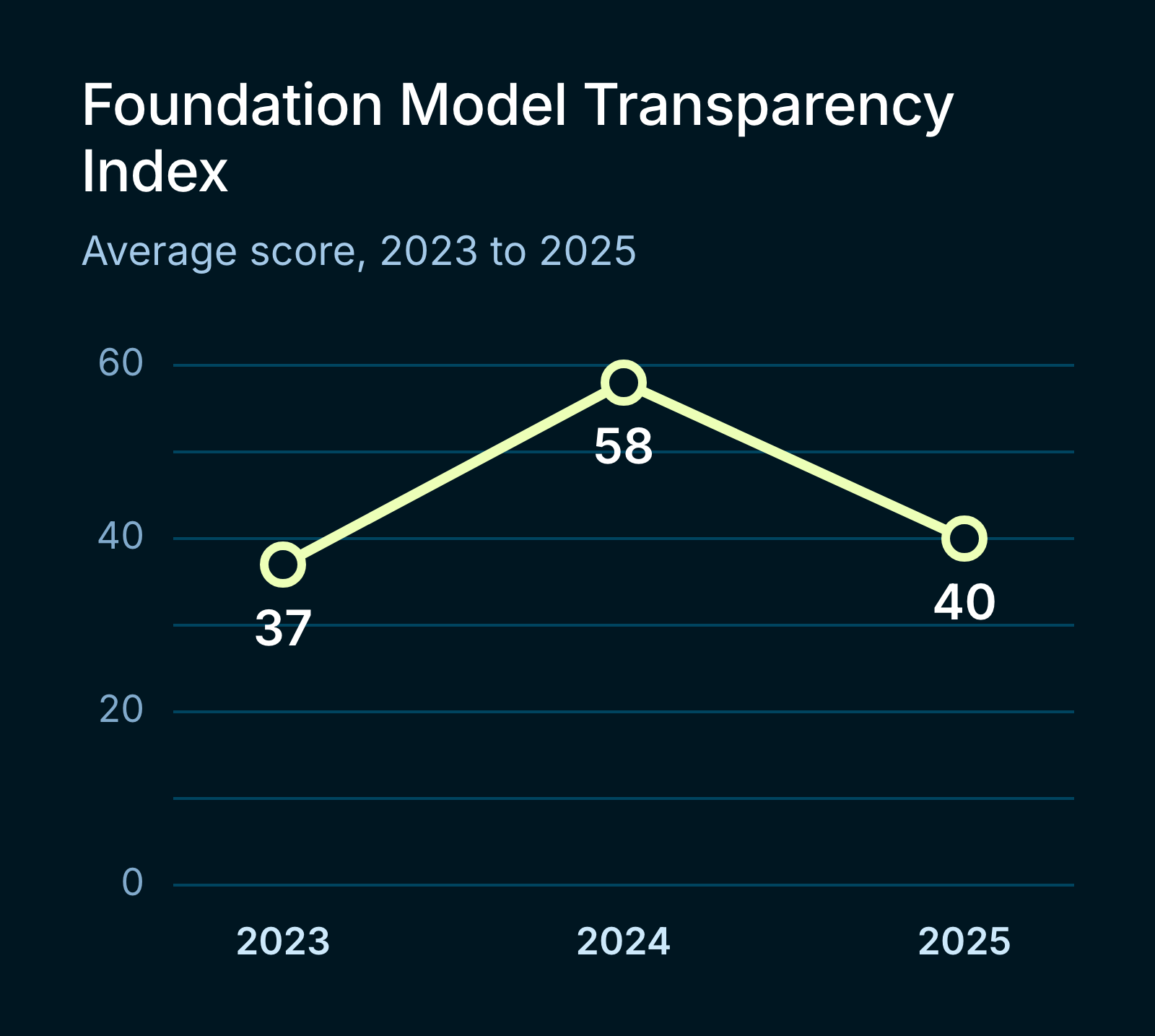
The report finds that documented AI incidents increased from 233 in 2024 to 362 in 2025. At the same time, the average Foundation Model Transparency Index score fell from 58 to 40.
Sources AI Index: Responsible AI
Since publication, governance has become even more concrete. On August 2, 2026, the European Commission began enforcing significant portions of the EU AI Act, including obligations for general-purpose models and transparency requirements for certain AI-generated interactions and content.
Sources European Commission, August 2 enforcement
Governance can no longer be treated solely as a policy document. It must appear in the system itself through access controls, audit trails, data boundaries, approval rules and clear responsibility when something goes wrong.
Execution becomes the moat
Stanford’s report is often read as evidence of how quickly AI is advancing. That is true, but it is only part of the story.
The Index also shows that capability is advancing faster than the systems surrounding it. Adoption is widespread, but deep integration remains limited. Models perform extraordinary tasks while failing surprisingly ordinary ones. Individual productivity can rise far faster than completed organizational output. Transparency is declining as dependence increases.
Together, these findings point toward the next source of competitive advantage.
As capable intelligence becomes widely available, value moves into how it is applied: selecting the right model, redesigning the right process, controlling ongoing costs, measuring the right outcome and retaining human responsibility for consequential decisions.
At BraidNest, we view AI as one component within a larger operating system. The goal is not to place the most powerful model everywhere. It is to build a dependable structure in which different forms of intelligence, human, proprietary and open, are applied where they create the most meaningful result.
When intelligence becomes abundant, execution becomes the moat.
The next phase of AI advantage will be defined less by access to intelligence than by the systems built around it.
Research reviewed through August 18, 2026. This article is strategic commentary, not investment advice.