
The recent “SaaSpocalypse” debate has produced two competing stories.
In one, AI agents replace familiar applications and bring the software-as-a-service era to an abrupt end. In the other, the market has overreacted to another technology cycle and established software companies will emerge largely unchanged.
Both stories miss the more immediate problem.
Software is not disappearing. But the commercial logic that supported much of the industry is becoming less reliable.
For two decades, a seat performed several jobs at once. It represented a user, a unit of adoption, a reasonably predictable level of activity and a rough share of the value the product created. As customers added employees, vendors added revenue. Because the marginal cost of serving another user was usually low, the model also produced attractive and relatively predictable margins.
AI separates those relationships.
One employee may now supervise several agents. Those agents may perform thousands of actions without opening the product’s interface. Their activity creates variable computing costs, but the volume of activity may have little connection to the commercial value delivered.
The question is therefore not whether the seat is dead.
It is whether a seat still represents enough of what is happening inside the product to remain a credible unit of value.
The market is repricing an assumption
The “SaaSpocalypse” label emerged from a sharp reassessment of software companies exposed to AI disruption. Investors began asking whether agents could reduce the number of employees using traditional applications, bypass product interfaces or perform work that previously required several specialised tools.
The reaction was severe, but it was not conclusive. Software stocks subsequently recovered some of their losses as companies demonstrated that AI could also increase demand for their platforms. Snowflake, for example, raised its product-revenue forecast in September 2026 and attributed approximately half of its recent growth acceleration to AI-related demand. Its consumption-based platform benefited as customers used more data and computing resources for AI workloads. Reuters: Snowflake’s AI-powered results lift its outlook
This does not prove that concerns about established software models were misplaced.
It shows that the effect of AI depends on how a company creates and captures value.
A vendor whose revenue expands when customers run more AI workloads may benefit from adoption. A company that charges according to the number of employees clicking through a workflow may face pressure if agents allow fewer people to produce the same amount of work.
The market debate is therefore less about the continued existence of software than the durability of its revenue architecture.
For founders and product companies, the important question is simple:
If the customer becomes more successful with the product, does the vendor’s revenue still move in the same direction?
Under traditional SaaS, the answer was often yes. Growing customers hired more people, bought more seats and expanded into higher tiers.
In an agentic system, a customer may become more productive while reducing headcount, consolidating tools and generating fewer human logins. The product can become more valuable while its existing pricing metric captures less of that value.
That is the contradiction software companies now need to resolve.
The seat was always a proxy
Customers do not ultimately value seats.
They value what authorised people can accomplish with the software.
The seat succeeded because it was a convenient proxy. It was easy to count, easy to invoice and familiar to procurement teams. Customers could forecast software spending from headcount, while vendors could forecast growth from hiring and adoption.
The model also divided responsibility cleanly. The vendor provided access to a functioning product. The customer remained responsible for using it effectively and producing the desired commercial outcome.
AI complicates that division because the product is beginning to perform more of the work itself.
Consider a customer-support platform.
In the conventional model, the company pays for each support employee using the system. The software organizes conversations, provides information and helps the employee resolve requests. More support volume usually requires more employees and therefore more seats.
An AI agent can handle a portion of that volume without a corresponding increase in human users. If the agent performs well, the customer may need fewer support seats precisely because the software is delivering more value.
The seat has not become meaningless. Human employees still require identity, permissions, collaboration tools and oversight capabilities. But it no longer accounts for the complete value or cost of the system.
The pricing architecture needs another dimension.
AI breaks four relationships at once
The difficulty is greater than replacing one metric with another. AI weakens four relationships that previously reinforced each other.
One user no longer represents one unit of work
A user may direct many agents, while an agent may perform work across several systems. Activity can expand without a comparable increase in headcount.
This makes adoption difficult to infer from seats alone. A product with 50 human users and extensive agent activity may be more deeply embedded than one with 500 occasional users.
Usage no longer corresponds neatly to users
Traditional software usage was naturally constrained by human time. An employee could only create so many records, run so many reports or complete so many workflows in a working day.
Agents operate at a different speed. They can initiate parallel tasks, use several tools and repeat operations until a condition is satisfied. One authorised user can therefore generate a highly variable amount of system activity.
Usage now creates meaningful variable costs
Most conventional SaaS products could add another user without substantially changing the cost of service. AI introduces inference, retrieval, orchestration, monitoring and third-party model costs that rise with activity.
The cost of serving two customers on the same plan can differ significantly if one uses occasional assistance and the other runs autonomous workflows continuously.
Activity does not guarantee value
More tokens, model calls or agent actions may indicate adoption. They may also indicate inefficient prompts, unnecessary retries or a poorly designed workflow.
An agent can produce a large number of drafts without generating a useful document. It can recommend hundreds of leads without identifying a qualified opportunity. It can hold a long customer conversation without resolving the issue.
AI therefore creates more activity than the customer necessarily wants to buy.
The pricing challenge is to select a unit that reflects value closely enough for the customer while covering cost reliably enough for the vendor.
There are three different things a vendor can charge for
The language around AI pricing often treats usage, consumption and outcomes as variations of the same idea. They represent materially different transfers of risk.
Bain separates the market into three broad meters: effort, output and outcome.
Effort-based pricing charges for resources consumed, such as tokens, computing capacity or agent time. Output-based pricing charges for completed units of work, such as a summary generated, a record updated or a lead recommended. Outcome-based pricing charges only when the work produces an agreed commercial effect, such as an issue being resolved or revenue being collected.
In Bain’s analysis of approximately 200 B2B software companies, around 35% of the AI pricing models used an effort-based meter and 55% used an output-based meter. Only about 10% used a true outcome-based model. Bain: AI Pricing—A Reality Check on Effort, Usage, and Outcomes
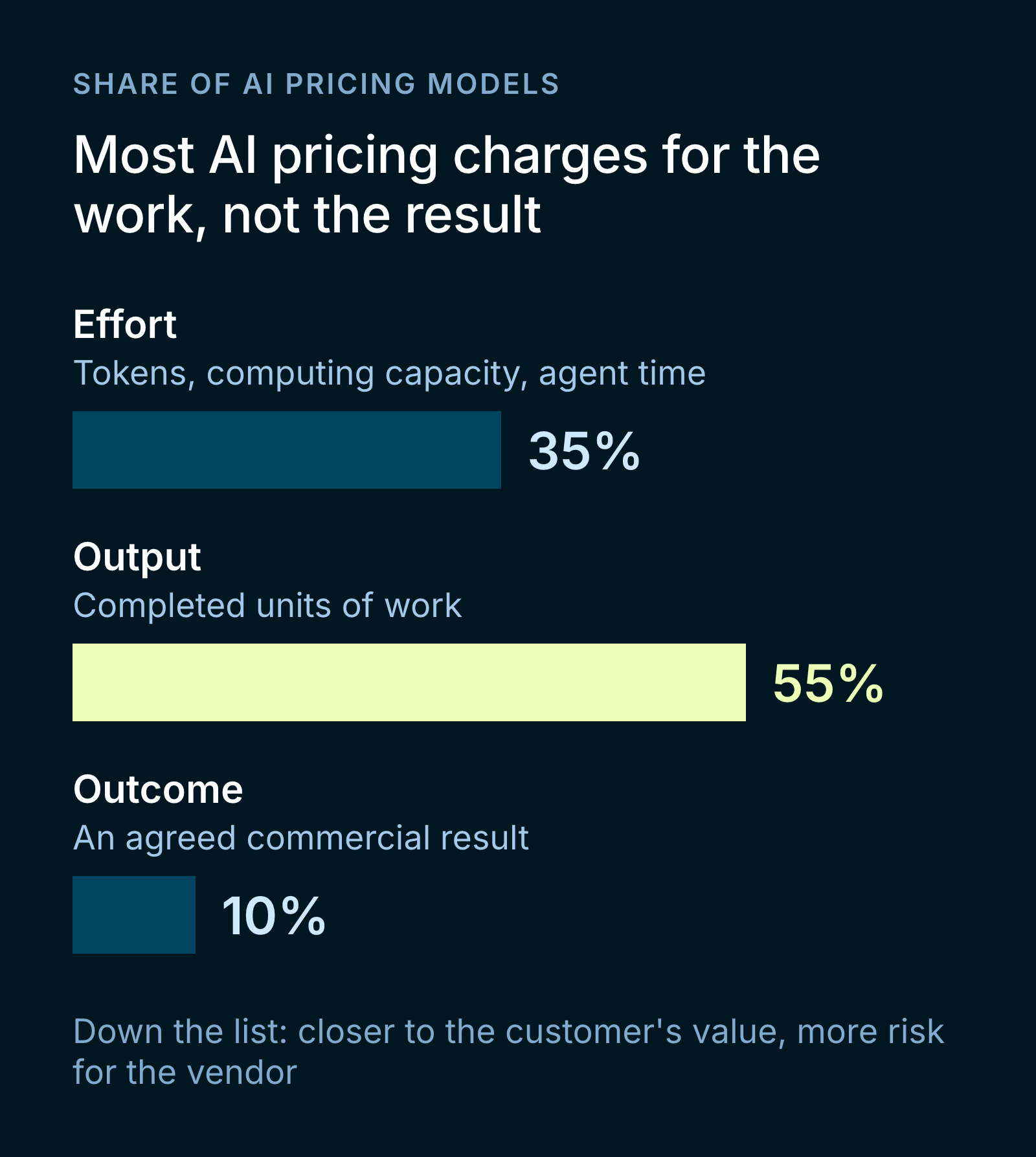
The distribution is revealing.
Outcome pricing attracts attention because it promises perfect alignment between buyer and seller. In practice, most companies stop closer to the work itself.
Effort is measurable, but commercially distant
Tokens, computing time and agent actions are relatively easy for a vendor to observe. They also connect directly to cost.
This makes effort-based pricing suitable for infrastructure products and broad platforms whose customers use the same technical resources for many purposes.
Salesforce’s Agentforce pricing illustrates the model. Customers can buy Flex Credits that are consumed when an agent performs actions such as updating a record, answering a question or executing a workflow. The company also offers conversation, resolution and user-based options, showing how several meters can coexist within one platform. Salesforce: Agentforce pricing
The weakness is that customers rarely want tokens or actions for their own sake.
They must estimate how technical consumption translates into a process they understand. An inefficient workflow can cost more without creating more value, while an optimization that reduces consumption can lower the vendor’s revenue even when the customer receives the same outcome.
Effort pricing aligns revenue with vendor cost. It does not automatically align price with customer value.
Output is easier to recognize
Output-based pricing moves the meter closer to the work the customer intended to produce.
The unit might be an invoice processed, a document reviewed, a meeting scheduled or a record enriched. Customers can understand these units more easily than tokens, and vendors can normally identify them without gaining access to the customer’s financial performance.
But output still leaves the customer carrying quality risk.
A generated sales lead is an output. Whether the lead is relevant, qualified or converted is a separate question. A completed document review may contain the expected classifications while still requiring extensive human correction.
Output pricing works best when the unit is clearly defined, consistently useful and difficult to inflate with low-quality activity.
Outcomes transfer more risk to the vendor
Outcome-based pricing takes the final step. Payment depends on an agreed effect rather than the effort expended or work produced.
Intercom currently combines conventional helpdesk seats with a charge for each Fin outcome. Its definition includes cases in which a customer confirms that an issue was resolved, does not request further help after the response or reaches the end of a specified workflow. Fin can also be purchased without seats for use with another helpdesk. Intercom: Fin and helpdesk pricing
Customer support is unusually suitable for this model because a conversation has a beginning, an observable resolution state and an identifiable system involved in producing it.
Many other functions are less accommodating.
A sales agent may recommend an opportunity, but the eventual purchase can depend on price, brand, product quality and a salesperson’s work. A recruitment system may identify a candidate, but hiring and retention depend on several people and events over many months. A fraud tool may block suspicious activity while also rejecting legitimate customers.
The closer pricing moves to commercial outcomes, the more valuable the unit becomes—and the harder it is to define.
Outcome pricing is a measurement system before it is a billing model
“Pay for results” sounds simple until the contract must explain what counts as success.
The vendor and customer must agree on a source of truth, a measurement period and a treatment for reversals. They need to determine whether the outcome can be attributed to the product and how human contribution should be handled.
A resolved support conversation might reopen the next day. Revenue collected may have arrived without the system’s intervention. A meeting booked by an agent may be cancelled, duplicated or attended by someone without buying authority.
Each ambiguity can become a billing dispute.
A credible outcome model therefore needs to answer questions such as:
- What event creates a charge?
- Which system records that event?
- What quality threshold must be met?
- How long must the outcome persist?
- What happens when the outcome is reversed?
- Can the customer contest the classification?
- How are duplicates and partial completions treated?
- Which factors are outside the vendor’s control?
Bain argues that outcome pricing works when the result is observable, attributable to the AI and capable of being defined contractually. Those conditions exist in some workflows, but not across software generally. Bain: limits of outcome-based AI pricing
When these conditions are absent, outcome pricing can become an attractive phrase attached to an output meter.
The distinction matters because the risk is different. A vendor charging for a generated recommendation is paid whether the recommendation creates value. A vendor charging for a qualified opportunity is accepting responsibility for part of its quality.
Before adopting an outcome model, a company must be prepared to operate the measurement and dispute-resolution system that makes the outcome credible.
Someone must absorb the variability
Every pricing model determines where uncertainty sits.
Under direct consumption pricing, the customer carries much of the usage risk. If agents perform more actions than expected, the bill rises.
Under a fixed subscription, the vendor carries more of the cost risk. Heavy users may consume enough computing resources to weaken or eliminate the margin on their accounts.
Under outcome pricing, the vendor assumes an additional layer of performance risk. It may incur substantial costs attempting work for which it is paid only when the agreed outcome occurs.
That does not make one model inherently superior. It means the pricing decision cannot be separated from product architecture.
A vendor offering predictable prices needs controls over unpredictable costs. These might include an allowance within each plan, limits on agent activity, more efficient models for routine work, premium charges for complex workflows or approval requirements before expensive actions are performed.
Customers also need the ability to control their exposure. Usage dashboards, spending alerts, hard limits and clear overage rules are becoming part of the commercial product, not merely administrative features.
Pricing establishes the promise. Architecture determines whether the vendor can afford to keep it.
The market is moving toward committed capacity
The most practical response is often neither unlimited access nor pure pay-as-you-go consumption.
It is capacity.
Under a capacity model, the customer commits to a defined quantity of credits, actions, outputs or outcomes for a period. The commitment gives the vendor a recurring revenue base and gives the customer a budget it can approve. Overage terms accommodate growth without making the initial purchase open-ended.
Bain found that approximately four in five vendors introducing AI pricing were using capacity rather than charging solely for consumption. Unused capacity commonly expires instead of being refunded or rolled over. Bain: capacity is emerging as the preferred AI pricing model
Economically, this retains an important feature of seat-based SaaS: the customer pays for entitlement, not only for what it ultimately uses.
Commercially, it acknowledges that enterprise buyers value predictability.
A finance team can approve an annual commitment with known thresholds more readily than an unbounded stream of model calls. The customer gains room to experiment, while the vendor gains enough revenue certainty to plan infrastructure and support.
This helps explain why hybrid structures are becoming common:
- A platform fee plus agent credits.
- Paid human seats plus automated resolutions.
- A minimum annual commitment plus usage overages.
- A subscription tier containing an allowance of AI work.
- A fixed operational fee plus a narrowly defined success payment.
Hybrid pricing is not merely a temporary compromise. It can reflect the fact that modern software provides several types of value simultaneously.
The platform may offer human collaboration, permissions, data management and governance through seats. AI capabilities may produce additional value and costs that require a separate meter.
The danger is complexity. If customers need a spreadsheet to understand every action an agent might consume, the pricing system can impede adoption even when the economics are sound.
The most useful meter is not necessarily the one that captures value with the greatest theoretical precision. It is the one both sides can understand, forecast and verify.
The meter changes the product
Pricing is sometimes treated as a commercial layer applied after the product has been built.
In AI software, the meter shapes what the product is designed to do.
A per-seat model encourages the vendor to increase the number of active users and spread the product through the organization.
An effort-based model rewards consumption. Unless carefully structured, it can allow inefficient processes to generate more revenue than efficient ones.
An output model rewards completion. If the definition is weak, the product may optimize for quantity rather than usefulness.
An outcome model rewards an agreed effect, but it may encourage the vendor to avoid difficult customers or cases with a lower probability of success.
These incentives enter the design of the system.
A support product paid for resolutions needs a defensible definition of resolution and must not suppress necessary escalation. A sales product paid for meetings needs to distinguish valuable conversations from calendar volume. A collections product paid for recovered revenue needs rules for attribution and customer treatment.
The unit of value becomes an optimization target.
Founders should therefore test a potential pricing metric not only against revenue potential but against the behaviour it will produce. A metric that encourages the wrong product decisions will eventually weaken customer trust, even if it initially improves monetization.
Seats will remain where people remain central
The seat still makes sense when the primary value of the product is attached to a person’s access, judgment or collaboration.
Design tools, management systems, professional applications and internal workspaces often serve identifiable users who require their own permissions, histories and interfaces. In these products, AI may make each user more capable without replacing the importance of the user.
The appropriate response may be a higher-value seat, an AI allowance included within the plan or a premium tier for advanced capabilities.
Seats also provide a useful governance function. Organizations need to know who can access information, authorize actions and accept responsibility. An agent may perform the work, but a human or organizational identity may still need to own its permissions.
The mistake is not continuing to use seats.
It is using them by default when the product’s value, activity and cost have moved elsewhere.
Changing the price requires changing the company
Moving beyond seats is not a website-pricing exercise.
The company must be able to measure the new unit accurately, produce invoices customers can audit and explain how future spending will behave. Sales teams accustomed to discussing users and feature tiers need a different commercial conversation. Finance must forecast revenue with new forms of variability. Product and engineering teams need instrumentation that connects activity to customer accounts and agreed outcomes.
Existing customers create another challenge.
A sudden move to variable pricing can feel like the vendor is monetizing activity that was previously included. Even customers that expect to save money may resist a model they cannot forecast.
The transition should therefore produce evidence before it produces a new invoice.
A company can begin by instrumenting usage and issuing shadow bills that show what customers would have paid under alternative models. Design partners can test whether the proposed unit corresponds to value. Spending caps and allowances can reduce early uncertainty. New customers can adopt the model before established contracts are migrated.
The vendor should monitor more than revenue.
It needs to understand adoption, gross margin, customer savings, expansion behaviour and the distribution of cost across light and heavy users. An average can conceal a small group of accounts whose activity makes the model uneconomic.
Before choosing a new meter, a software company should be able to answer:
- What event indicates that the customer received value?
- Can both parties observe and verify it?
- How closely does the event correspond to the vendor’s cost?
- Who controls the volume of activity?
- Can the customer forecast and limit its bill?
- Can the vendor preserve its margin when usage exceeds expectations?
- What behaviour will the metric encourage?
- Does the model remain workable when the customer becomes more efficient?
If the answers point to different units, the product may need a hybrid structure rather than a single universal price.
The unit of value is becoming a product decision
The SaaS industry is not moving from one settled model to another.
It is entering a period in which different layers of the same product may need to be priced differently. Human access, automated effort, completed work and commercial outcomes can coexist within one system.
The strategic task is to decide which layer the customer is actually buying.
At BraidNest, we see pricing as part of product architecture. The product defines where value is created, the technical system determines what can be measured, and the commercial model decides how risk is shared between vendor and customer.
Those decisions need to be made together.
A company that prices too close to its costs may struggle to communicate value. One that prices too close to an ambitious outcome may accept risks it cannot measure or control. One that remains tied to seats may find that adoption and revenue no longer move together.
The seat will not disappear.
It will stop being accepted as sufficient evidence that value has been created.
The next durable software businesses will choose units that customers can predict, vendors can afford and both sides can recognize as value.