

On August 2, 2026, the European Commission and national authorities moved from preparing for the EU AI Act to enforcing significant parts of it. The Commission's powers over general-purpose AI models became active, while Article 50 introduced new transparency obligations for AI interactions and synthetic content.
This is no longer only a period of preparation. Complaints, whistleblower reports and regulatory investigations can now lead to demands for information, corrective measures and fines.
For businesses, the practical question is not simply whether an AI product works.
It is whether the company can explain what the system does, which regulatory role it occupies, how risks are controlled and why the product may be offered in the European market.
August 2 was not a single compliance switch
The AI Act has entered application in stages.
Prohibited AI practices and AI-literacy obligations began applying in February 2025. Obligations for providers of general-purpose AI models followed in August 2025. On August 2, 2026, the Commission's enforcement powers became active and the transparency obligations under Article 50 began to apply.
The most extensive requirements for high-risk AI systems have been delayed under the EU's AI Omnibus. Rules covering sensitive uses such as employment, education, biometrics, critical infrastructure and migration will apply from December 2, 2027. Requirements for AI embedded in regulated products, including certain medical devices and machinery, will apply from August 2, 2028.
The delay matters, but it should not be mistaken for a pause.
High-risk compliance will require risk-management systems, technical documentation, data governance, human oversight, logging, conformity assessment and post-market monitoring. These are not controls that can be added several weeks before a deadline. They affect how a product is designed, tested, sold and supported.
The companies that use the transition period well will not merely prepare better documentation. They will build products that can survive regulatory and enterprise scrutiny without being redesigned at the point of market entry.
Sources European Commission, AI Act regulatory framework
The Act regulates the use case, not simply the model
One of the most important features of the AI Act is its attention to intended purpose.
The same underlying model may be used to draft marketing copy, rank job applicants, identify suspicious financial activity or control a medical device. The technical foundation may be similar, but the regulatory treatment can be entirely different.
This means compliance cannot begin and end with selecting a model provider.
A company must first determine:
- What outcome is the system intended to influence?
- Who places it on the market?
- Who operates it?
- Who is affected by its output?
- Does the system merely support a process, or does it materially influence a consequential decision?
The Act also assigns distinct roles across the value chain. A provider develops an AI system, or has one developed, and places it on the market under its own name. A deployer uses the system under its authority. Importers, distributors, product manufacturers and authorised representatives can carry separate obligations.
A company may occupy several roles at once. A European business using a third-party model internally may be a deployer. If it turns that model into a branded product and sells it to customers, it may also become a provider of the resulting AI system.
Responsibility can change again if a downstream company substantially modifies a high-risk system or changes its intended purpose.
The Act reaches beyond Europe
The AI Act has a deliberately broad territorial scope.
It applies to providers placing AI systems or general-purpose models on the EU market, regardless of whether the provider is established in Europe. It can also apply to providers and deployers outside the Union when the output of the system is used inside the EU.
Sources EU AI Act, Article 2
A California company does not avoid the Act by keeping its servers, employees or legal entity in the United States.
If it offers an AI product to European customers, or its system produces outputs used in Europe, it may fall within scope. Non-EU providers of high-risk systems must also appoint an authorised representative established in the Union before making those systems available in the European market.
Sources EU AI Act, Article 22
European market access depends on what the product does and what the company can prove about it, not where the software was built.
The risk structure determines the obligation
The AI Act is commonly described as risk-based, but its structure is more precise than a simple scale from low to high.
Some practices are prohibited outright. These include certain forms of manipulation, social scoring, predictive policing based solely on profiling, untargeted facial-image scraping and emotion recognition in workplaces or educational institutions.
A second category covers systems subject to specific transparency obligations. These include interactive AI systems, generative systems, deepfakes, emotion-recognition tools and certain AI-generated publications.
High-risk systems include uses that can materially affect safety or fundamental rights. Employment screening, creditworthiness assessments, access to education, biometric identification and certain medical applications can fall into this category.
Most ordinary uses remain minimal risk and do not acquire extensive obligations under the AI Act. A spam filter, internal drafting assistant or AI-enabled video game will generally be treated differently from a system that determines whether someone receives a job, loan or essential service.
General-purpose AI models sit across this structure as a separate regulatory layer. Their providers face obligations concerning technical documentation, downstream information and copyright. Providers of models presenting systemic risk carry additional duties around evaluation, security and risk mitigation.
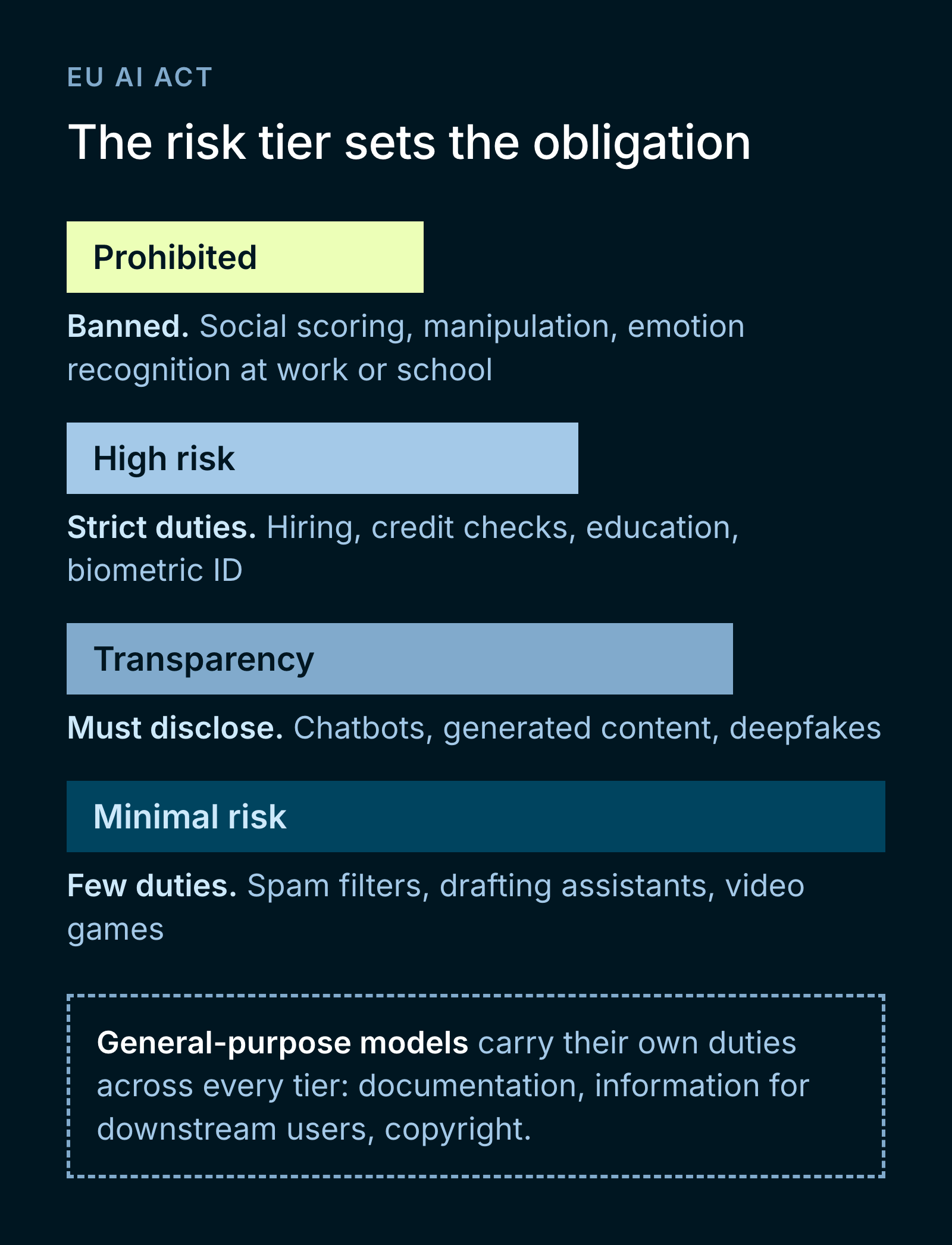
The classification exercise is therefore foundational. If it is wrong, every compliance decision that follows may also be wrong.
Sources European Commission, AI Act overview • Navigating the AI Act
Transparency has become product behaviour
The most immediately visible change from August 2 is Article 50.
Providers of systems that interact directly with people must design them so users are informed that they are dealing with AI, unless that fact would already be obvious to a reasonably observant person. The disclosure must appear clearly from the beginning of the first interaction.
This covers systems such as chatbots, AI agents and digital avatars. A general statement buried in terms and conditions is unlikely to perform the same function as a disclosure presented within the experience itself.
Providers of generative AI systems must also support detection of synthetic text, audio, images and video through effective machine-readable marks. Deployers carry a separate obligation to provide a visible or audible disclosure when publishing deepfakes. A hidden machine-readable mark does not replace the human-facing label.
AI-generated text concerning matters of public interest must also be labelled when it is published without substantive human review or editorial control. Spell-checking or a superficial approval step does not amount to meaningful review. The reviewer must possess relevant knowledge and authority to approve, alter or reject the substance of the content.
The Commission has provided a limited grace period until December 2, 2026, for the machine-readable marking of content produced by generative systems placed on the market before August 2. The other Article 50 obligations do not receive the same general extension.
Sources European Commission, Article 50 transparency FAQ
The transparency rules show why compliance must enter product design.
The obligation affects interfaces, generated files, content pipelines, metadata standards, publishing workflows and customer instructions. It is not satisfied solely through a policy document.
The voluntary Code of Practice on AI-generated content provides one recognised route for demonstrating compliance. Companies that choose another approach must be able to show that their measures are equivalently adequate. By the end of July, approximately 190 organizations had signed the Code.
Sources European Commission, Code of Practice on AI-generated content
General-purpose model enforcement now reaches the supply chain
The rules for general-purpose AI models began applying in August 2025. Since August 2, 2026, the AI Office has been able to enforce them directly.
Providers must maintain technical documentation, give downstream system providers information needed to understand the model's capabilities and limitations, adopt policies addressing EU copyright law and publish a summary of the content used in training.
Providers of models presenting systemic risk face additional obligations. These include model evaluations, systemic-risk assessments, incident reporting and cybersecurity protections.
The AI Office can request documentation, require access for model evaluations, order corrective measures and, when necessary, restrict a model's public availability.
Sources European Commission, AI Act enforcement
Most companies building AI products will not become providers of the underlying general-purpose model. But the rules still affect them.
A downstream product provider needs sufficient information to evaluate the model it has integrated. Procurement must consider whether the model supplier provides usable documentation, communicates material changes and supports the product's own compliance obligations.
A vague vendor relationship can therefore become a product risk.
If the underlying model changes without adequate notice, the downstream system's evaluations, instructions and risk profile may no longer be accurate. Model selection must be accompanied by version control, testing and a credible replacement strategy.
High-risk compliance has been delayed, not diminished
The high-risk rules are the most operationally demanding part of the Act.
Before a high-risk system reaches the market, its provider will need a continuous risk-management process. Training, validation and testing data must meet governance and quality requirements. The system must generate appropriate logs, provide usable information to deployers and support meaningful human oversight.
Accuracy, robustness and cybersecurity must be assessed against the system's intended purpose. Providers will also need technical documentation, a quality-management system, conformity assessment, an EU declaration of conformity, registration and post-market monitoring.
Deployers have their own responsibilities. They must use the system according to its instructions, monitor performance and assign oversight to people with the competence and authority to intervene. When the deployer controls input data, that data must be relevant and sufficiently representative for the intended use.
Certain deployers must inform affected people when a high-risk system is used in decisions about them. Employees and worker representatives must be informed before high-risk AI is introduced in the workplace. People affected by qualifying decisions may also have a right to receive a meaningful explanation.
Sources European Commission, Navigating the AI Act
A nominal human approval step will not necessarily satisfy these expectations.
Oversight must be operational. The reviewer needs enough information to understand the output, authority to reject it and time to exercise independent judgment. A process in which employees approve nearly every recommendation without meaningful examination may preserve the appearance of human involvement while failing to control the underlying risk.
Example case: A US recruitment platform entering Europe
Consider a California-based software company that provides an AI recruitment platform.
The platform summarizes CVs, ranks applicants, recommends interview candidates and uses an AI agent to communicate with them. The company wants to sell the system to employers in France, Germany and the Netherlands.
The first conclusion is territorial. The provider is outside the EU, but it is placing an AI system on the European market. The AI Act applies.
The second conclusion concerns roles. The US company is the provider of the recruitment system. The European employer is its deployer. The developer of the general-purpose model used inside the product remains the model provider.
The third conclusion is classification. A system intended to analyse applications, filter candidates or influence recruitment decisions is listed as a high-risk employment use case. Its candidate-facing AI agent also falls under the transparency rules already in effect.
The product team must therefore address two timelines.
Today, it should disclose the AI agent clearly, ensure staff and contractors have appropriate AI literacy, avoid prohibited capabilities and comply with existing European data-protection and employment law. If the product claims to infer a candidate's emotional state from an interview, that feature could fall within the prohibition on workplace emotion recognition.
By December 2027, the provider must be ready for the high-risk requirements. That means documented risk controls, validated data practices, technical files, logging, human-oversight functionality, conformity assessment, registration, an EU representative and a post-market monitoring process.
The European employer will need instructions that are sufficiently specific to govern real use. It must appoint competent human reviewers, monitor the system and inform affected people where required.
The product design should reflect those obligations:
- Candidate rankings should be accompanied by relevant evidence or reason codes.
- Recruiters should be able to reject recommendations without procedural friction.
- Model and prompt versions should be recorded.
- Material changes should trigger reevaluation.
- Performance should be tested across the populations and contexts in which the system will be used.
- Complaints, overrides and unexpected outcomes should feed into post-market monitoring.
The company might instead narrow the product's purpose. A tool limited to interview scheduling, document collection or administrative communication may carry a different risk classification from one that evaluates and ranks candidates.
But the distinction must exist in the actual product. Rebranding a decision system as an "assistant" does not change what it does.
This is where compliance and product strategy begin to overlap.
The company must decide whether the high-risk function is central to the customer value proposition. If it is, the appropriate response is to build the required controls. If it is not, removing the function may reduce regulatory burden without weakening the product.
Governance must produce evidence
The EU AI Act turns governance from a collection of principles into an evidence-producing operating system.
A credible compliance structure begins with an inventory of AI systems. Each entry should document the intended purpose, users, affected people, underlying models, data sources, regulatory role and preliminary risk classification.
The organization then needs ownership. Product, engineering, security, legal, compliance and operational teams should know who approves a use case, who monitors it and who can stop deployment.
Controls must be connected to evidence. Risk assessments need evaluation results. Human-oversight claims need interface controls, documented authority and override records. Data-governance claims need provenance, quality criteria and retention rules. Transparency obligations need both user-facing disclosures and technical marking where required.
Vendor governance also becomes part of the control environment. Contracts should address documentation access, model changes, security incidents, audit cooperation and the information needed to support downstream compliance.
Finally, the system needs change control. A new model, data source, prompt structure or target customer can alter the product's risk profile. Compliance cannot be assessed once and assumed to remain valid indefinitely.
The AI Act does not replace the GDPR
AI Act compliance is only one part of European market entry.
If a system processes personal data, the GDPR may still require a lawful basis, data minimisation, transparency, security and, in higher-risk cases, a data-protection impact assessment. Restrictions on certain forms of solely automated decision-making may also apply.
A product can satisfy an AI Act disclosure requirement while still processing personal data unlawfully. It can also comply with the GDPR while failing to meet AI Act requirements concerning human oversight, model documentation or conformity assessment.
The European Data Protection Board has emphasised that AI development and deployment must still be assessed under existing GDPR principles, including lawful basis, anonymity, data protection by design and automated decision-making safeguards.
Sources European Data Protection Board, AI models and GDPR principles
Companies therefore need an integrated compliance architecture, not parallel checklists owned by teams that rarely communicate.
Enforcement changes the commercial calculation
Violations involving prohibited practices can attract fines of up to €35 million or 7% of worldwide annual turnover, whichever is higher. Other breaches can reach €15 million or 3%. Incorrect or misleading information supplied to authorities can also be penalised.
Sources European Commission, AI Act enforcement
The financial exposure is important, but enforcement changes the market in another way.
European customers, investors and procurement teams now have a clearer basis for asking how an AI product is classified, what documentation exists and who remains responsible when something goes wrong.
A company that cannot answer those questions may face a commercial barrier before it faces a regulator.
Conversely, a product with credible documentation, transparent behaviour and operational controls can reduce friction during procurement. Compliance readiness becomes part of enterprise trust and, increasingly, part of product-market fit.
Compliance is becoming part of the product
The EU AI Act does not require every company to build a large compliance department.
It does require companies to make deliberate decisions.
They must know which systems they operate, why those systems exist and which people are affected. They must distinguish experimentation from production use, assistance from decision-making and a third-party model from the complete system offered to customers.
Most importantly, they must build controls that function in practice.
At BraidNest, we view regulatory fit as part of product-market fit. Our team includes EU-based experts who understand the European market and its evolving regulatory expectations, alongside the product and systems expertise needed to translate those expectations into working technology.
This allows us to help companies entering Europe assess intended use, shape compliant product requirements and build the governance controls needed for a credible route to market. Where formal legal interpretation is required, that work can be coordinated with qualified counsel while BraidNest focuses on turning the resulting requirements into product architecture and operating processes.
A system that cannot pass customer due diligence, disclose its operation or produce evidence of its controls is not fully prepared for the market it intends to enter.
The opportunity is to address those questions while the product can still be shaped, before compliance debt becomes a barrier to launch or growth.
In Europe, compliance is no longer paperwork that follows product design. It is becoming part of the product itself.
Regulatory developments reviewed through August 20, 2026. This article is strategic commentary and does not constitute legal advice.