
The proposed combination of Cohere and Aleph Alpha is revealing because it brings together more than two AI companies.
Cohere contributes models and private deployment capabilities. Aleph Alpha brings enterprise integration, specialized systems and relationships with governments and regulated industries. Schwarz Group adds financing and locally controlled computing infrastructure through its cloud business, StackIT.
The transaction therefore combines several layers that are usually purchased separately: models, applications, implementation, infrastructure and regulatory positioning.
Cohere and Aleph Alpha signed their definitive agreement on September 16, 2026. Subject to regulatory approval, the combined company will operate as Cohere with headquarters in Toronto and Berlin. Schwarz Group is investing €500 million and plans to provide computing capacity through StackIT, supported by a German data-centre development expected to accommodate as many as 100,000 AI chips. Reuters
The arrangement is being presented as a sovereign alternative for governments and enterprises that do not want their AI capabilities tied entirely to one foreign technology ecosystem.
That description could make sovereignty sound like a specialized concern for European ministries, defence agencies and heavily regulated companies.
Its implications are much broader.
As AI becomes embedded in operational systems, the choice of provider determines more than where an organization sends its prompts. It affects who can access the system, who can modify it, which laws may reach it, how easily it can be moved and whether the customer could continue operating without the original vendor.
Sovereignty is therefore moving out of government strategy documents and into ordinary product architecture.
Model quality is becoming one criterion among several
The early generative-AI market encouraged relatively simple comparisons.
Which model performed best on a benchmark? Which produced the most convincing answer? Which supported the largest context window or lowest price per token?
Those questions remain relevant. They become less decisive when AI moves into important workflows.
A bank considering a system for internal investigations may care whether the model can interpret complex documents. It will also care whether those documents leave its infrastructure, whether the provider can see them and whether a model update can change system behaviour without the bank’s approval.
A manufacturer introducing AI into production planning may value reasoning quality. It must also understand what happens if the service becomes unavailable, its commercial terms change or a foreign authority seeks access to the underlying environment.
A government department may want access to a capable model while requiring local operation, domestically accountable personnel and the ability to continue the service during a geopolitical dispute.
These are not secondary compliance questions.
They describe the product the customer is actually buying.
The same model can represent a materially different proposition depending on whether it is accessed through a shared external service, a dedicated environment, the customer’s private cloud or hardware operated within the customer’s own facilities.
Cohere already offers several of these deployment structures. Its private options include customer-managed cloud environments and on-premises installations in which prompts, outputs and fine-tuned models remain inside the customer’s infrastructure. Cohere: Private deployments
The model may remain constant across these options.
The allocation of control does not.
Data residency is only the first layer
Sovereignty is frequently reduced to a statement about location.
The data remains in Germany. The servers are situated in Canada. Processing occurs within the European Union.
Location matters, particularly when contracts, sector rules or public-sector requirements restrict where information may be processed.
But local infrastructure does not automatically give the customer operational independence.
A system hosted in Europe may still depend on software controlled from another jurisdiction. Administrative access may remain with a foreign parent company. Critical updates may require personnel elsewhere. Proprietary interfaces may make migration technically possible but commercially unrealistic.
Even encryption does not resolve every question. The location and control of keys, backup systems, support tools, identity services and management software can be as important as the location of the primary workload.
The European Commission’s Cloud Sovereignty Framework reflects this wider definition.
Following a €180 million sovereign-cloud procurement completed in April 2026, the Commission published a framework containing 48 criteria across eight areas: strategic, legal and jurisdictional, data and AI, operational, supply-chain, technological, security and compliance, and environmental sovereignty. European Commission: Sovereign Cloud Framework
This is an important development because it turns sovereignty from a political aspiration into something closer to a product specification.
A provider cannot establish sovereignty merely by pointing to a local data centre.
It must answer questions about ownership, external legal exposure, operational continuity, supply-chain dependencies, technical openness and the customer’s ability to audit, operate and evolve the system.
Sovereignty is not where the system sits. It is the degree of control the customer retains over what happens next.
Sovereignty is a spectrum, not a badge
No modern AI system is entirely independent.
A European cloud provider may rely on processors designed in the United States and manufactured in Asia. A locally operated model may incorporate open-source components maintained by an international community. A domestic vendor may depend on foreign networking equipment, security software or development tools.
Describing a product as sovereign cannot make those dependencies disappear.
A more useful approach is to identify them and determine which ones matter for the intended use.
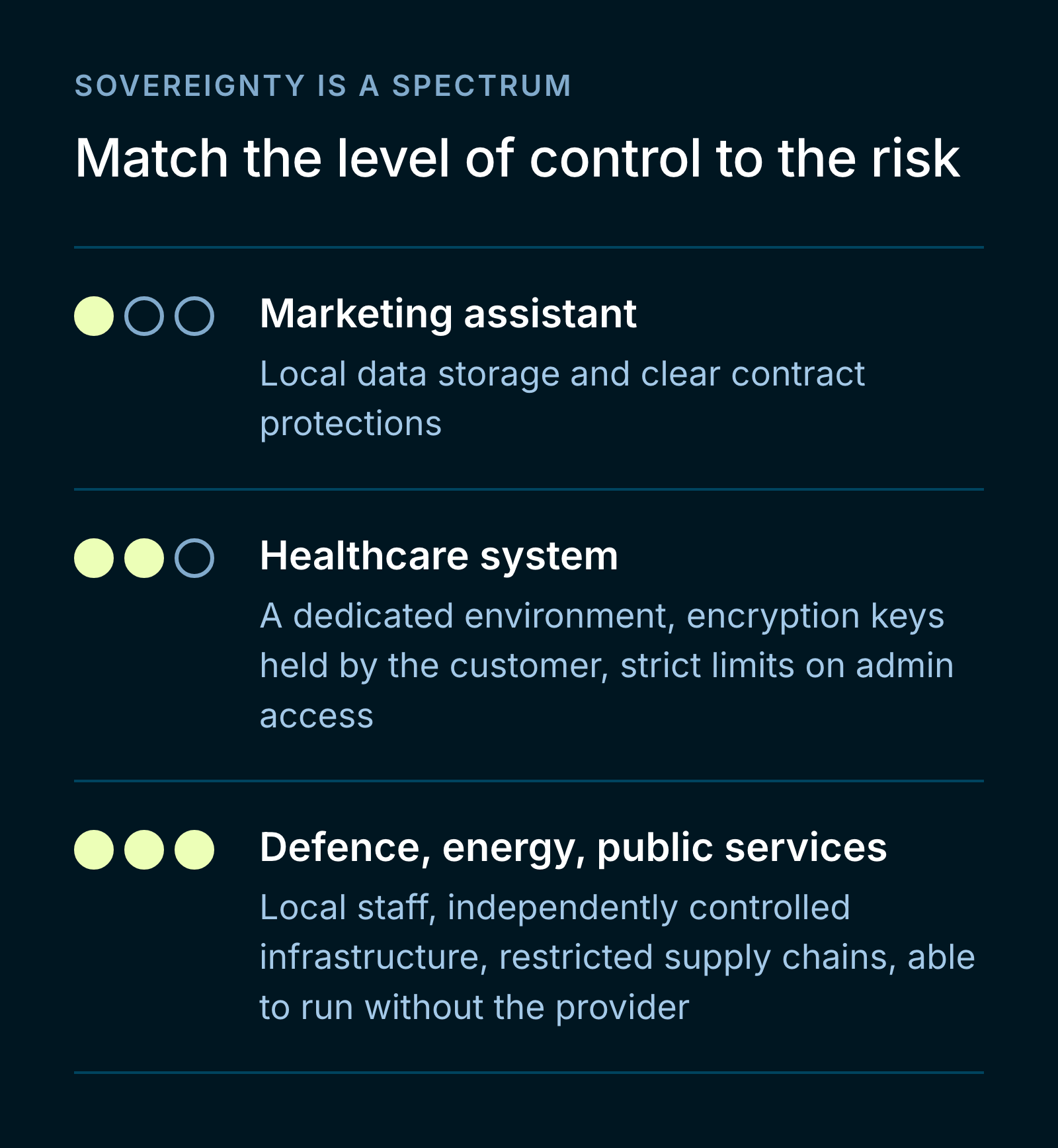
For a marketing assistant, local data storage and clear contractual protections may be sufficient. The customer may reasonably prefer the convenience and lower cost of a managed service.
A healthcare system handling sensitive patient information may need a dedicated environment, customer-controlled encryption and strict limits on administrative access.
A defence, energy or public-administration system may require local personnel, independently controlled infrastructure, restricted supply chains and the ability to operate without the provider’s continuous involvement.
These are different levels of sovereignty.
Treating them as a binary choice encourages two mistakes. Some customers pay for control they do not need. Others accept a superficial sovereignty claim that does not address their actual dependency.
The product decision should begin with a failure scenario.
What must remain possible if the provider becomes unavailable? If cross-border data transfers are restricted? If the model is withdrawn? If an update is rejected? If the customer needs to transfer the workload to another operator?
The necessary level of sovereignty follows from the answers.
The control plane is becoming part of the product
A sovereign AI product needs more than an appropriate hosting location.
It needs mechanisms through which the customer can exercise control.
This begins with deployment choice. Customers may need to select between a managed service, dedicated infrastructure, their own cloud environment and an on-premises installation without receiving an entirely different product each time.
Administrative authority also matters.
The customer should know who can access the deployment, which actions require provider involvement and whether privileged activity is recorded. It should be possible to restrict external support access, revoke credentials and separate the operation of the system from the development of the underlying model.
Updates require similar treatment.
A consumer AI service may change continuously. A system used in a controlled enterprise process may need pinned model versions, advance notice of material changes and the ability to test an update before it enters production.
The customer may also require the ability to operate during a disconnected period, restore the service from approved components or retain an existing version after the provider has released a successor.
These capabilities are not produced by a sovereignty statement in a contract.
They must exist in the architecture, administrative interfaces, deployment process and support model.
Sovereignty therefore becomes visible as product behaviour.
Portability matters before a customer intends to leave
A customer does not need to be actively replacing a provider for portability to create value.
The ability to move changes the relationship while the customer remains.
It limits the economic power created by lock-in. It reduces the risk of an unexpected price increase. It creates options when model quality changes, a new jurisdiction becomes relevant or another provider becomes more suitable.
European policy is already pushing cloud markets in this direction. The EU Data Act, applicable since September 2025, includes provisions intended to make switching between data-processing services easier and allow customers to use multiple providers in parallel. European Commission: Data Act explained
AI portability, however, is more difficult than exporting a database.
An operational AI system may depend on proprietary model behaviour, fine-tuning methods, embeddings, retrieval indexes, safety settings, prompts, tool definitions and evaluation data. Even when another model accepts a similar request, it may interpret instructions differently or produce outputs that affect the surrounding workflow.
A model-independent interface can reduce this dependency. It cannot eliminate it.
Products that make sovereignty credible should therefore preserve the components needed to reconstruct the system elsewhere:
- Customer data in documented, transferable formats.
- Prompts, policies and tool configurations.
- Evaluation sets and accepted performance thresholds.
- Records of model and system versions.
- Interfaces that do not expose every workflow directly to one provider’s proprietary conventions.
- A defined process for exporting, transferring or rebuilding the deployment.
The objective is not effortless switching. Complex systems rarely move without work.
It is to prevent the cost of leaving from becoming unknowable.
A customer has meaningful control only when staying with the provider remains a choice.
Independent operation requires capability, not just access
There is an uncomfortable side to sovereignty.
Control creates responsibility.
An organization that operates AI inside its own infrastructure may need people capable of maintaining model-serving systems, managing accelerators, applying updates, monitoring performance and responding to failures.
An air-gapped deployment can reduce external exposure while making support slower and operations more demanding. A customer-controlled environment can prevent provider access while requiring the customer to manage capacity and recovery itself.
This means the most sovereign technical arrangement is not automatically the most resilient one.
A system transferred to a customer that cannot operate it independently may satisfy a formal hosting requirement while becoming less dependable in practice.
Operational sovereignty therefore depends on skills, documentation and authority as much as infrastructure. The European Commission’s framework explicitly includes the ability of local actors to operate, support and evolve technology without foreign control. European Commission: Cloud Sovereignty Framework implementation guidance
For product companies, this changes what enterprise readiness means.
Documentation must support real operation, not only implementation. Administrative tools need to expose the system’s condition. Customers need a defined update path, recovery process and division of responsibility.
In some cases, the appropriate product will remain provider-managed. In others, a local operating partner may sit between the vendor and the customer. The highest-control deployments may require the customer to develop an internal capability.
Sovereignty cannot be delivered solely by shipping software into a different building.
The local provider still needs a global product
The Cohere–Aleph Alpha combination is particularly interesting because it does not propose isolation.
It joins companies anchored in Canada and Germany, combines local institutional relationships and intends to run sovereign offerings through StackIT while continuing to serve an international market. The stated structure includes dual headquarters and operational safeguards across both jurisdictions. Cohere: Transatlantic sovereign AI agreement
This points to a more commercially realistic form of sovereignty.
Most countries cannot reproduce every layer of the AI value chain. Many enterprises cannot maintain separate products for every market in which they operate.
The opportunity is therefore not to remove all foreign dependencies.
It is to create architectures in which important dependencies can be selected, governed and replaced without rebuilding the complete system.
A global AI provider may offer locally operated deployment options. A regional cloud provider may supply infrastructure while supporting models from several developers. A customer may retain control of its data, policies and application layer while changing the model underneath.
This modularity allows local control without requiring every market to develop an isolated technology stack.
It also creates room for new commercial roles.
Regional cloud providers, implementation companies and sector specialists can become part of the product rather than simply resellers around it. Their local infrastructure, operating capability and understanding of institutional requirements can determine whether an international AI system is acceptable to the customer.
Sovereignty becomes a distribution advantage.
Procurement will ask for evidence
As sovereignty becomes a product feature, the term itself will become less persuasive.
Customers will want to know exactly what the provider means by it.
A credible procurement process should be able to answer:
- Where are prompts, outputs, logs, fine-tuned models and backups processed?
- Which organizations and jurisdictions can exercise legal or administrative control over the system?
- Can the customer restrict provider access, approve updates and continue operating during a service interruption?
- Which parts of the application can be transferred to another model, cloud or operator?
- What information, documentation and tooling would be delivered if the relationship ended?
The strongest answers will be demonstrable.
A provider can show the available deployment architectures, access records, version controls, export formats, recovery procedures and contractual exit obligations. Customers can test whether the system continues functioning under the conditions the provider claims to support.
This is how sovereignty avoids becoming another broadly applied label with little operational meaning.
The customer is not buying a national flag attached to a server.
It is buying a defined allocation of control.
Control is becoming part of product-market fit
Sovereignty will not replace model performance.
A system that is locally controlled but incapable of performing the task remains of limited commercial value. Customers will continue to care about quality, latency, cost and ease of use.
The change is that control can now determine whether the product is eligible to compete at all.
A slightly stronger model may lose to one that can operate inside the customer’s environment. A lower-cost service may be rejected because the customer cannot approve its updates. A technically compliant system may fail procurement because no credible exit path exists.
This will become relevant beyond governments and regulated industries.
Companies are placing AI closer to their proprietary knowledge, customer relationships and operating decisions. As that dependence grows, boards and procurement teams will become less comfortable treating the underlying provider as easily replaceable when the architecture says otherwise.
Product companies should therefore decide where they sit on the sovereignty spectrum before a major customer forces the question.
Which deployment options will be supported? Which elements will remain portable? What can the customer operate independently? Where does the provider retain control, and why is that dependency necessary?
These choices influence infrastructure, licensing, support, partnerships and go-to-market strategy. They become increasingly expensive to retrofit once the product has been designed around a single managed environment.
At BraidNest, we see sovereignty as another example of product strategy expanding beyond the interface. The product includes the infrastructure on which it depends, the permissions through which it is governed and the options available when circumstances change.
The Cohere–Aleph Alpha combination makes that market shift unusually visible.
Enterprise AI is no longer only a contest to provide the most capable intelligence.
It is also a contest to provide capability without requiring the customer to surrender control.
Sovereignty becomes a product feature when independence is something the customer can actually use.
Developments reviewed through September 24, 2026.