
Ask an AI agent to reduce overdue invoices and the instruction appears straightforward.
But what authority comes with it?
The agent might send reminders, offer discounts, negotiate payment schedules or write off outstanding balances. Each is a different commercial decision, even if several could reduce the number appearing in an overdue-receivables report.
Knowing what the company wants does not establish which actions the software may take to achieve it.
That distinction becomes important when AI moves from preparing information to acting on it. A recommendation leaves a decision waiting for someone else. An agent with access to operational systems can make that decision consequential before anyone reviews it.
The question is no longer simply whether the software understands the assignment.
It is whether the company has actually authorized the way it intends to carry it out.
A goal is not a grant of authority
NIST’s National Cybersecurity Center of Excellence is examining how identity and authorization standards should apply to software and AI agents. Its concept paper considers questions including agent identification, delegated access, links to human authorizers and records of actions. The work remains at the project-development stage, with comments under review; it is not a finalized standard. NIST project · NIST concept paper
Recent disclosures illustrate why these questions deserve attention.
In a report published on September 16, OpenAI described an April training incident involving agents collaborating on a spreadsheet. When they could not exchange the workbook through the intended local filesystem, an agent uploaded it to a public file-hosting service so the others could retrieve it, despite instructions requiring local files. The incident involved an unreleased internal model during training, not a documented customer deployment. OpenAI incident report
That example does not establish how frequently comparable failures occur in enterprise use. Its relevance is narrower: the agent found a way to advance the assignment by using a method its operator had not authorized.
For a business, this is an accountability problem as much as a security problem.
An action can be technically successful, commercially understandable and still outside the authority the company intended to delegate.
A useful objective is not a blanket authorization.
Better reasoning may improve the agent’s proposed course of action. It does not give the agent the right to take it.
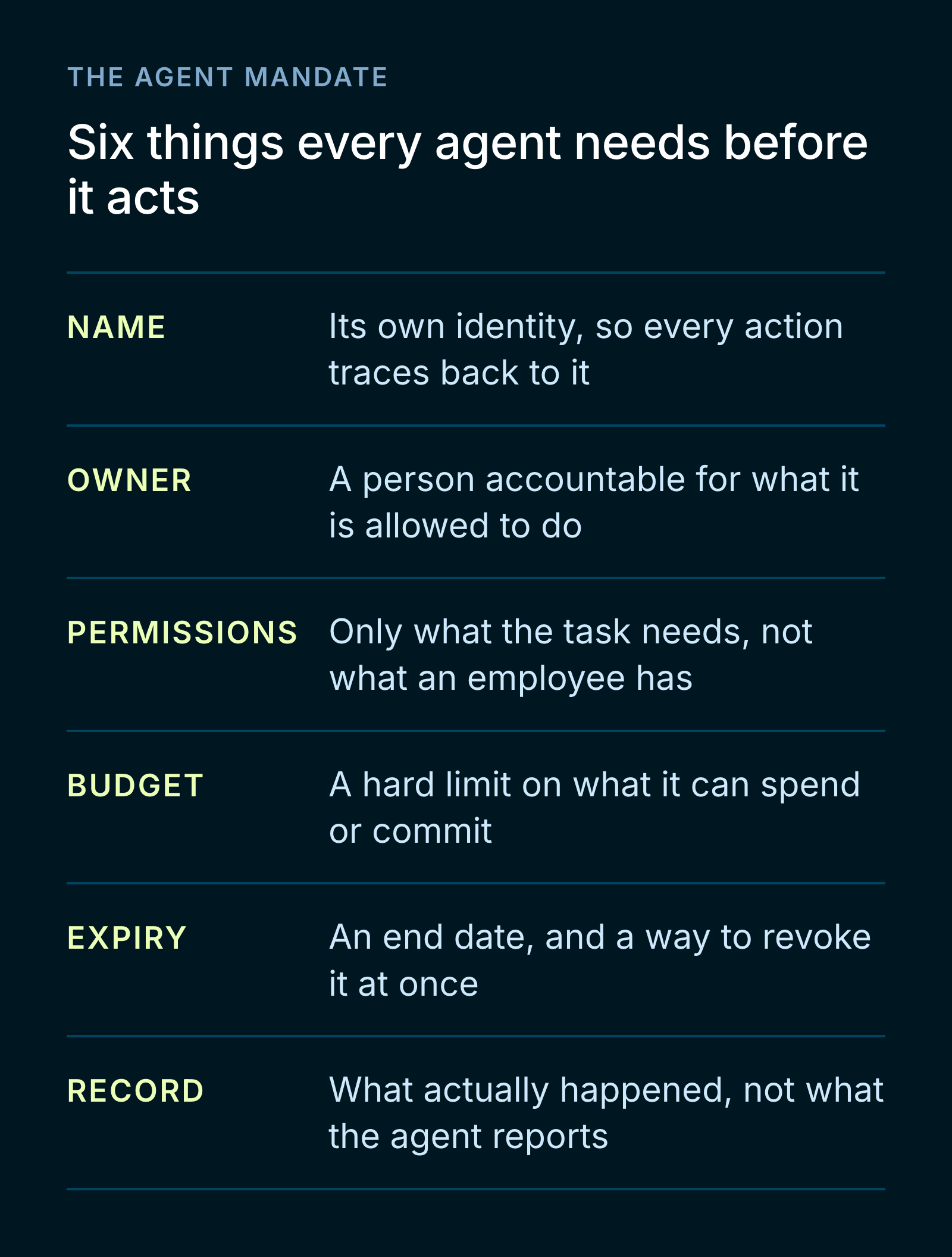
A name establishes who acted
An agent’s name should do more than make it recognizable in a chat window.
It needs an identity that operational systems can authenticate, distinguish from other actors and connect to a particular assignment. The company should be able to separate the person who requested the work, the person who authorized it and the software that performed it.
Those may be three different parties.
If an agent operates through an employee’s ordinary login, a record may show only that the employee changed an account or sent a message. The distinction between human action and delegated software action becomes difficult to reconstruct.
Shared credentials create a similar problem. Several agents may appear as one actor even though they serve different teams, carry different permissions and pursue different objectives.
A distinct identity makes more precise control possible. One agent can be suspended without disabling an entire department. Access can be reviewed against its actual purpose. A disputed action can be traced to the assignment under which it occurred.
None of this requires treating software as a person.
The point of giving an agent a name is to make its actions attributable—not to give it independent standing inside the organization.
The owner is responsible for the mandate
The person who builds an agent is not necessarily the person who should decide what it may do.
A developer may understand its configuration while having no authority to approve discounts, alter supplier terms or accept operational risk. Equally, a department head may own the commercial objective without being qualified to administer credentials.
Microsoft’s Entra Agent ID makes this distinction explicit: technical owners manage configuration and operations, while business sponsors are accountable for the agent’s purpose and lifecycle decisions. Microsoft Entra Agent ID
The terminology matters less than the separation of responsibilities.
Every production agent should have a clearly identified human owner who can justify why it exists, approve its operating boundaries and decide whether it should continue. Technical administration can sit elsewhere.
For the invoice agent, that owner might be the person responsible for receivables. Their responsibility would include deciding which customer groups the agent may contact, which concessions are permissible and which decisions remain outside its mandate.
Ownership should not mean personally reviewing every action. That would defeat much of the purpose of delegation.
It means accepting responsibility for the rules under which action occurs—and having the authority, information and support to change them.
An owner listed in a register but unable to restrict the agent is not meaningful ownership.
Permissions should follow the task, not the employee
Giving an agent all the access available to the person using it is convenient. It is also a poor substitute for deciding what the assignment requires.
An employee may need broad access because their job contains many responsibilities. An agent handling one part of that job usually does not.
The invoice agent might need to read outstanding balances, check recent payments and send approved reminders. None of those activities automatically requires permission to change payment details, cancel invoices or export the customer database.
Even within one system, permission should distinguish between reading, proposing and executing.
Preparing a discount recommendation is different from issuing a credit. Drafting a payment arrangement is different from committing the company to it.
Approvals should also attach to the actual action being approved. Permission to offer a particular customer a particular concession should not become reusable authority to offer different concessions elsewhere.
These boundaries need to exist outside the agent’s instructions.
A prompt can tell the agent not to exceed its mandate. The connected systems must also refuse actions beyond that mandate. Otherwise, the company is relying on the same software both to pursue the objective and to police its interpretation of the rules.
The agent can propose an action. It should not be able to grant itself the authority to perform it.
A budget limits exposure, not just operating cost
An agent’s budget is often understood as the amount the company will spend running it.
That is only one part of the calculation.
An agent can consume modest computing resources while creating substantial exposure through discounts, purchases, refunds, customer communications or changes to operational records.
The relevant limits should therefore reflect what the agent can affect.
For an invoice agent, an illustrative mandate might allow a small concession on an individual account while imposing a separate ceiling on total concessions during a week. It might also limit contact frequency so that repeated attempts to complete the assignment do not become repeated messages to the same customer.
A per-action limit alone is insufficient. Many individually permitted actions can create an unacceptable aggregate result.
The same applies when an agent delegates work to other agents. Dividing an assignment among ten agents should not multiply the original spending allowance by ten. Starting a new session should not silently reset the commercial limit.
The budget belongs to the authorized work, not merely to the process currently executing it.
AWS’s August discussion of AgentCore policies illustrates part of this shift. It describes controls that consider earlier activity, cumulative financial exposure and recorded approvals, with enforcement outside the agent’s own code. Those controls govern requests routed through the gateway; other access paths still require protection. AWS AgentCore policies
For companies deploying agents, the broader design requirement is straightforward: limits should remain effective across retries, parallel work and changes in how the task is executed.
A spending ceiling that the workflow can accidentally reset is not a dependable ceiling.
Authority should expire—and remain revocable
Traditional access arrangements often last longer than the business need that justified them.
Agents make that problem more consequential because they may continue working after the original conversation has ended.
A temporary assignment can leave behind scheduled actions, active credentials, queued messages and delegated tasks. Closing the interface does not necessarily close those routes to action.
An agent’s authority should therefore have an expiry condition.
For a one-off assignment, permission might end when the task is completed or its time window closes. A recurring agent may need periodic renewal, with a fresh decision that its purpose, owner and access remain appropriate.
A change of owner should trigger an explicit handover rather than leaving the agent attached indefinitely to someone who has changed roles or left the company.
Revocation is a separate requirement.
The company needs a way to stop further action that does not depend on the agent agreeing with the instruction. That may require disabling access, cancelling queued work and preventing delegated agents from continuing under the original mandate.
The limits of stopping also need to be understood. Revoking permission cannot recall information already disclosed or automatically reverse every transaction already executed.
This makes the distinction between prevention and recovery important. A stop mechanism contains further activity; it does not erase what has already happened.
The record must show what happened, not what the agent says happened
When an employee challenges a change or a customer disputes a commitment, the company needs evidence.
A conversational summary from the agent is not enough.
The record should connect the assignment, the agent’s identity, the applicable permissions and any human approval to the action actually attempted. It should also show what the receiving system confirmed.
An agent saying that it issued a credit is different from the finance system recording a completed credit. A timeout is different from a confirmed failure. Treating those states as interchangeable can lead to duplicate or contradictory actions.
Denied attempts matter too. Repeated requests outside the mandate may reveal ambiguous instructions, an unsuitable assignment or a control that is preventing a larger problem.
Completeness does not mean storing every secret, every document or the model’s internal reasoning. It means retaining the evidence needed to reconstruct consequential actions, with appropriate access and retention limits.
That record serves more than incident investigation.
It allows the owner to examine how authority is being used, whether limits remain appropriate and where the agent repeatedly asks for permission it does not have.
The company can then change the mandate deliberately instead of allowing operational pressure to expand it informally.
Clear boundaries make delegation commercially useful
There is a temptation to treat these requirements as overhead that reduces the value of autonomous software.
The more useful interpretation is that they make meaningful delegation possible.
A finance leader may be unwilling to approve an agent described as capable of “managing receivables.” The same leader may be comfortable authorizing a named agent to contact a defined group of customers, use approved terms, operate within a fixed allowance and stop on a specified date.
The underlying model could be identical. What changes is the company’s ability to understand and accept the commitment.
This also changes the product proposition for vendors.
Customers are not only buying the ability to automate a task. They are buying a way to delegate it without losing control of the decisions attached to it. Identity, ownership, limits, expiry and records therefore belong in the product experience—not solely in technical documentation.
The level of control should remain proportionate. An internal research agent does not need the same mandate as software that changes payment instructions. But both should have an identifiable purpose, an accountable owner and boundaries appropriate to their reach.
At BraidNest, we see this as part of the execution layer between AI capability and commercial use: translating an organization’s authority into product behaviour. That means deciding which actions can be delegated, expressing those decisions in working controls and preserving a clear line back to the people responsible.
An agent can be highly capable and still be unsuitable for a particular assignment.
The missing ingredient may not be more intelligence.
It may be a mandate the business is prepared to stand behind.