
In October, GXO and Agility Robotics announced that Agility's Digit robots would expand into two additional logistics facilities.
The announcement followed several years of work at a GXO warehouse in Georgia, where Digit had moved more than 100,000 totes. The deployment began as a proof of concept, progressed into a multi-year Robots-as-a-Service agreement and is now moving toward multiple sites. GXO: Agility Robotics partnership expansion
What makes this commercially important is not that the robot can walk on two legs.
It is that a customer allowed the system to perform a repetitive task inside a live operation, accumulated enough evidence to continue and then expanded the relationship.
The industry often describes physical AI through autonomy: robots that perceive their surroundings, reason about unfamiliar situations and perform increasingly broad categories of work without human control.
That technological direction matters.
But businesses do not purchase autonomy in the abstract.
They purchase productive capacity.
A robot creates commercial value when it performs an accepted unit of work at the expected time, speed and cost - and when the operation can recover predictably when something goes wrong.
Autonomy may win the demonstration. Reliability wins the contract.
Robotics is scaling but physical AI is still proving itself
The robotics market is already substantial.
The International Federation of Robotics reported that five million industrial robots were operating in factories at the end of 2025. More than 600,000 new units were installed during the year, an increase of 11%. International Federation of Robotics: World Robotics 2026
Professional service robots are expanding as well. Global shipments increased by 24% in 2025 to almost 250,000 units, with transportation and logistics representing the largest application. International Federation of Robotics: Service Robot Sales
These figures demonstrate real demand for machines that move goods, clean facilities, inspect infrastructure and perform repeatable industrial work.
They do not yet demonstrate that general-purpose physical AI has reached comparable maturity.
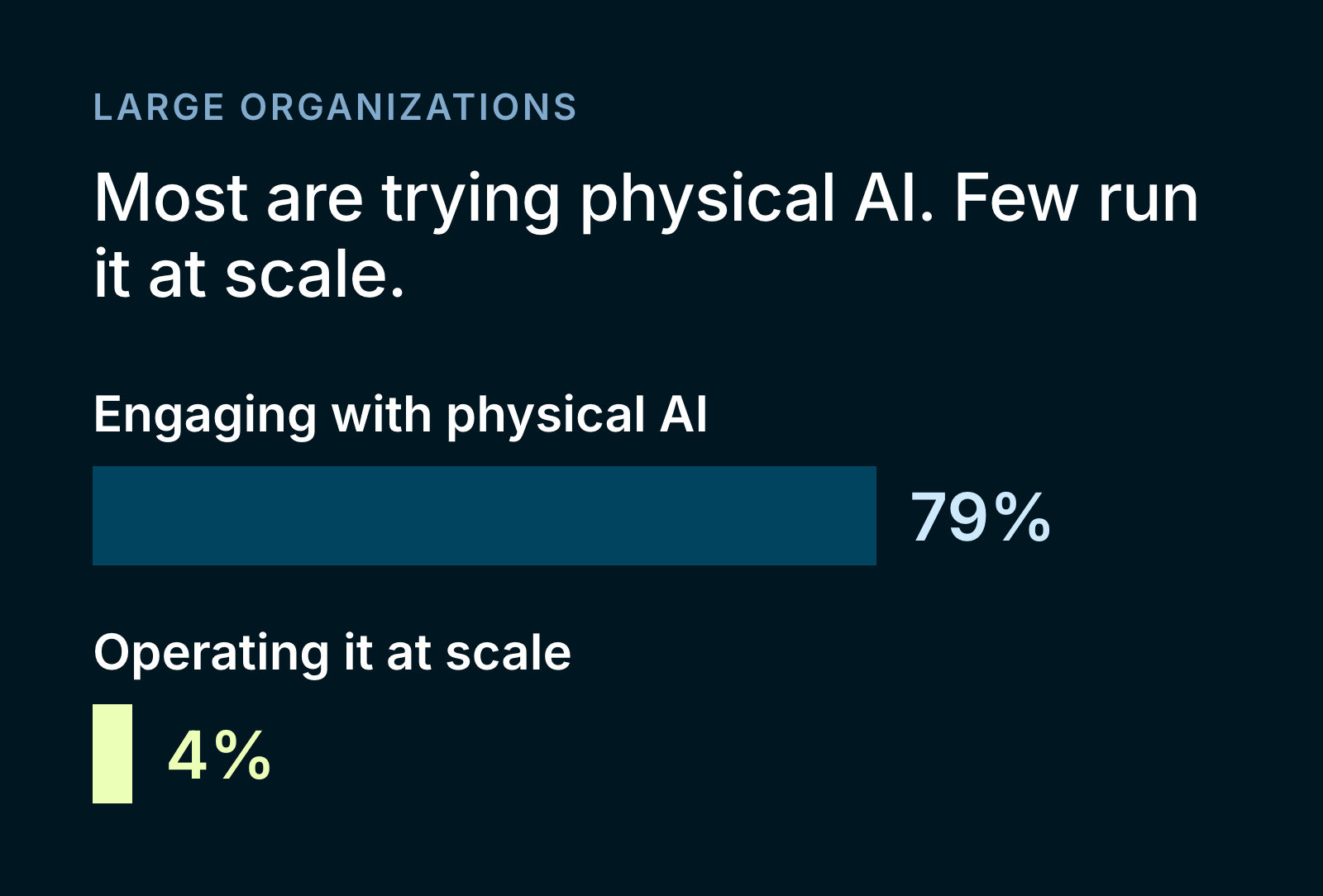
A 2026 Capgemini survey found that 79% of large organizations were engaging with physical AI, but only 4% said they were already operating it at scale. Among executives evaluating humanoid robots, 72% identified technical immaturity - including reliability and dexterity - as a barrier. High costs, training requirements and uncertain returns also remained significant concerns. Capgemini Research Institute: Physical AI
The distinction is important.
Traditional industrial robots have succeeded by performing narrow tasks inside carefully designed environments. Physical AI promises to make those machines more adaptable. It does not eliminate the industrial requirements that made the earlier systems useful.
The new robot may possess more intelligence.
It must still survive the shift.
Autonomy and reliability are different product qualities
Autonomy describes how much a system can do without human involvement.
Reliability describes whether the surrounding operation can depend on it.
A highly autonomous robot may still be commercially weak if it works slowly, fails unpredictably or requires frequent specialist intervention. A more constrained machine may be extremely valuable if it performs one useful task consistently for twenty hours a day.
This produces an apparent paradox.
Increasing autonomy can initially make the system less dependable.
A robot that follows a fixed path through a structured warehouse faces a limited number of conditions. A robot asked to interpret unfamiliar objects, select among several actions and coordinate a multi-step task has a much larger failure surface.
Each additional decision creates another place where perception, reasoning or execution can diverge from reality.
Reliability also compounds across a workflow.
As a simplified illustration, consider a task composed of twenty independent actions. If the robot completes each action successfully 99% of the time, the probability of completing the entire sequence without a failure is approximately:
0.99 multiplied by itself 20 times ≈ 82%
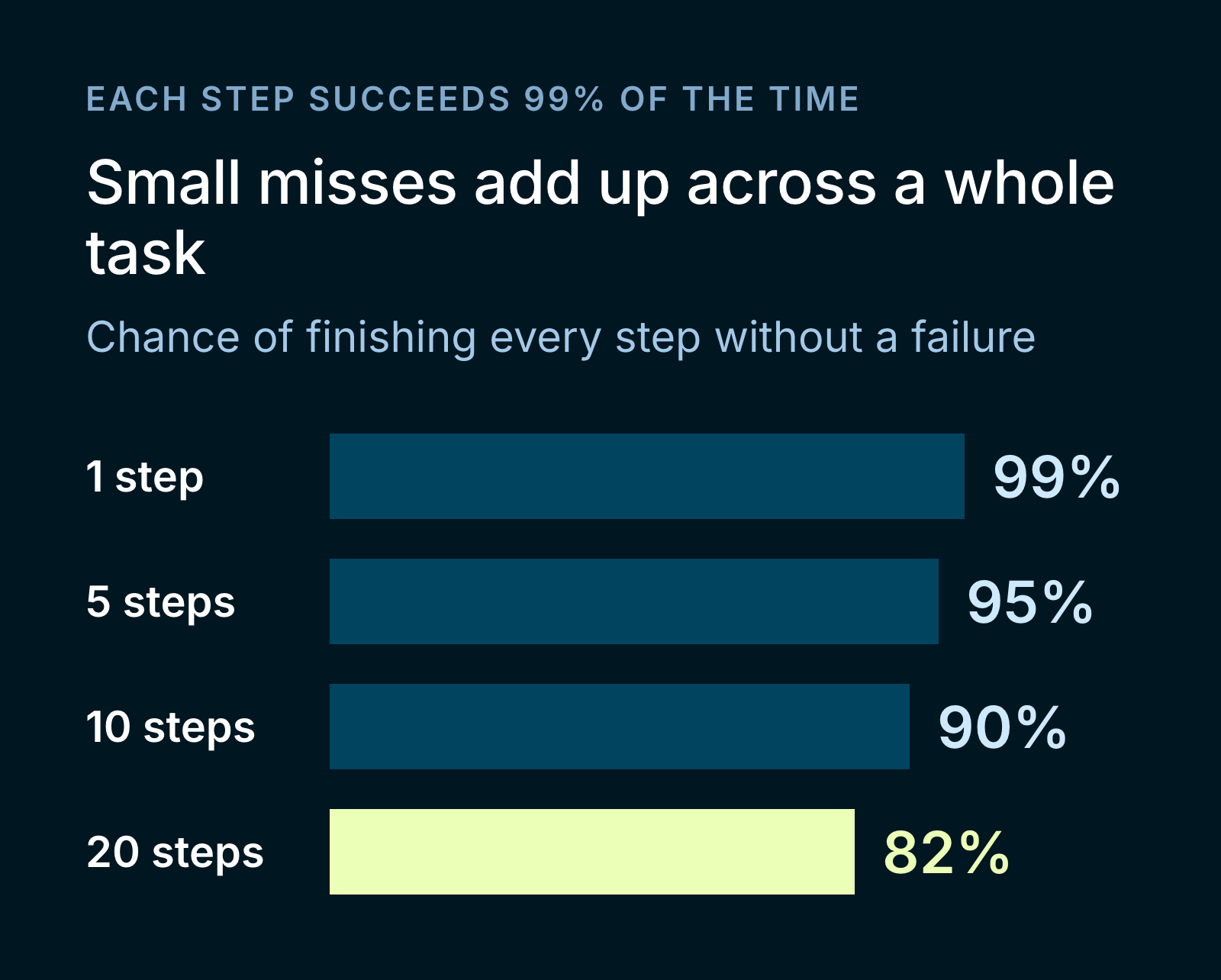
Real robotic tasks are more complicated than this calculation. Failures may be correlated, some actions can be retried and not every error prevents completion.
But the principle remains.
A high success rate on an isolated movement does not necessarily produce dependable completion of an entire job.
The commercial system must therefore include the ability to detect failure, recover its position, retry safely or transfer the exception without bringing the wider operation to a stop.
The environment is part of the product
Physical AI is often presented as a machine learning to operate in the world as it already exists.
Commercial deployments frequently work in the opposite direction.
The environment is adjusted to make the machine reliable.
Lighting may be improved. Containers can be standardized. Floor markings, wireless coverage, charging locations and handoff points can be changed. Objects may be presented at consistent heights and orientations. Human traffic can be separated from particular operating zones.
This is not an admission that the technology has failed.
It is normal systems engineering.
Research published by Epoch AI in 2026 found that autonomous navigation is already commercially deployed across warehouses, delivery and infrastructure inspection. Manipulation has been most successful in controlled environments where the objects, workflow and surroundings can be designed around the robot. Epoch AI: Where Autonomy Works
The further the system moves into variable environments and multi-step manipulation, the less dependable performance becomes. Transfer to unfamiliar objects and locations also remains rarely demonstrated.
BMW's deployment of Figure 02 illustrates the same principle.
During ten months at its Spartanburg plant, the robot moved more than 90,000 components across approximately 1,250 operating hours and supported the production of more than 30,000 vehicles.
The project also led BMW to revise safety barriers and improve 5G coverage inside the facility. The robot was connected through standardized interfaces and introduced in a body shop that already possessed substantial automation experience. BMW Group: Physical AI in Production
The result did not come from the robot alone.
It came from aligning the machine, workstation, connectivity, safety structure and production process.
Physical AI scales when the task, machine and operating environment are designed as one system.
Reliability is larger than task accuracy
A robot can achieve a strong success rate and still create a weak commercial result.
Task accuracy does not reveal whether the machine was available when needed, how quickly it performed, how often employees had to intervene or how much maintenance was required.
A useful reliability model should include several dimensions:
- Availability: How much of the scheduled operating period was the system ready for work?
- Completion: How frequently did it produce an accepted result without rework?
- Throughput: Did it maintain the required speed across a complete shift?
- Intervention: How often did a person need to assist, reset or remotely operate it?
- Recovery: How quickly could the system return to work after an exception?
- Safety: Did the system remain inside its operating boundaries without creating unacceptable risk?
- Maintainability: Could ordinary problems be resolved locally, or did every failure require a specialist?
- Integration: Did the robot coordinate correctly with conveyors, production systems, warehouse software and human teams?
These measurements should be evaluated together.
A robot may report 98% uptime while operating too slowly to meet the production requirement. It may complete 99% of attempts while leaving the remaining 1% as expensive, unpredictable disruptions.
A fleet-level average can also conceal local problems. Ten robots may collectively satisfy an availability target while the machine supporting the most important workstation remains unavailable.
The meaningful metric is therefore not simply uptime, autonomy or task success.
It is the cost and reliability of an accepted unit of work.
Recovery is part of the product
The presence of human intervention does not automatically make a robotic system unsuccessful.
The relevant question is what the intervention costs.
A rare remote confirmation that takes fifteen seconds may have little effect on the economics. A physical reset requiring a technician to cross a large facility can eliminate much of the expected benefit.
Intervention should therefore be treated as an engineered part of the service.
The system should identify what occurred, preserve the relevant sensor and decision history, place itself in a safe state and provide the operator with enough context to resolve the problem.
It should also distinguish between different forms of recovery.
Some failures can be corrected automatically. Others can be handled remotely. A smaller category may require an employee at the site, while serious conditions should prevent the machine from resuming until it has been inspected.
This creates an autonomy ladder rather than a binary distinction between autonomous and human-operated machines.
The robot may work independently during ordinary operation, request assistance for an unfamiliar condition and stop completely when safety cannot be established.
The strongest system is not necessarily the one that requests the least help.
It is the one that makes the need for help predictable, proportionate and inexpensive.
Simulation is becoming part of reliability engineering
Physical systems cannot be tested exclusively through live experimentation.
A software error may produce an incorrect answer. A physical error can damage inventory, stop a production line or create a safety incident.
Developers therefore need ways to evaluate uncommon conditions without repeatedly introducing them into an operating facility.
Simulation and digital twins are becoming part of that infrastructure.
NVIDIA has announced integrations with major industrial robotics companies to design and validate robotic applications and complete production lines through physically accurate digital twins. The objective is not simply to train more capable models. It is to test how a robot, facility and workflow behave together before deployment. NVIDIA: Physical AI and Robotic Simulation
Simulation does not remove the need for real-world validation. Sensor drift, component wear, unexpected reflections, connectivity loss and human behaviour can still produce conditions that the virtual environment failed to represent.
But it allows teams to test more cases, examine dangerous scenarios and evaluate changes before they reach a production system.
Over time, one of the most valuable assets in physical AI may therefore be the connection between simulated evaluation and operational evidence.
The company that can reproduce failures, test corrections and safely distribute improvements across a fleet possesses more than a robot model.
It possesses a reliability engine.
Safety belongs to the complete application
Physical AI also changes how product boundaries should be understood.
Safety cannot be assigned solely to the robot manufacturer.
The current ISO 10218 framework separates requirements for the industrial robot itself from requirements governing its integration into a complete application or robot cell. The distinction recognizes that a machine considered safe in isolation can become dangerous when combined with a particular tool, layout or workflow. ISO 10218-1:2025
AI-driven behaviour makes this integration question more important.
A system that can select actions dynamically must still operate within verifiable limits. It needs constraints governing speed, force, location, proximity to people and permissible actions.
The intelligence may be adaptable.
The safety envelope cannot be ambiguous.
This will create a commercial advantage for providers that can produce credible validation evidence, support site-level risk assessment and explain how software or model updates affect the approved operating boundary.
A new model version cannot simply be pushed to a physical fleet because it performs better on an abstract benchmark.
Its behaviour must be evaluated inside the application in which it will act.
Robots as a Service changes who carries the reliability risk
Robotics has traditionally required substantial capital expenditure.
The customer purchases equipment, pays for integration and absorbs much of the risk that the machine will be underused, difficult to maintain or unable to deliver the expected return.
Robots-as-a-Service changes that allocation.
The provider may retain ownership of the hardware and charge through a subscription, operating period, completed task or volume of work. Installation, monitoring, maintenance and software updates can become part of the service.
The model is gaining ground. IFR reported that Robots-as-a-Service had become the dominant business model among the US professional service-robot suppliers represented in its 2026 survey. The original GXO-Agility agreement was also structured as a multi-year RaaS deployment.
This is more than financing.
When the provider remains commercially responsible for the robot after installation, its incentives change.
Serviceability matters. Spare-parts availability matters. Remote diagnostics, deployment tooling and the cost of technician visits matter. A technically impressive machine that is expensive to support becomes a weak service business.
Reliability also becomes contractual.
Customers will increasingly expect commitments covering scheduled availability, response time, repair time, task acceptance and operational support.
The contract must define what counts as downtime, how blocked tasks are treated and who bears the cost when the site, payload, network or robot causes the failure.
A reliability guarantee without a measurement architecture is merely a marketing claim.
The humanoid form must earn its complexity
Humanoid robots receive disproportionate attention because their shape implies generality.
A machine with arms, legs and hands appears capable of entering environments designed for people without requiring the facility to be rebuilt.
That can be a genuine advantage.
But the human form also introduces complexity.
Walking consumes energy and creates balance problems. Hands with greater dexterity introduce more joints, sensors and failure points. A robot designed to perform many possible tasks may be less efficient than a wheeled platform or fixed arm designed for one high-volume workflow.
Customers do not necessarily need a human-shaped machine.
They need a machine compatible with human-shaped infrastructure.
Those are not always the same requirement.
Humanoids are most likely to earn their complexity where facilities cannot be redesigned easily, work occurs across several stations and task variety is sufficient to justify a general-purpose form.
Where the process is stable and the environment can be adapted, specialized machines may continue to provide better throughput, energy efficiency and reliability.
Form factor should follow the commercial task.
It should not be selected because it produces the most compelling demonstration.
Buyers should evaluate the operating system around the robot
A physical AI purchase should not begin with a general question about what the robot can do.
It should begin with a specific unit of work.
Before moving from pilot to deployment, the buyer should be able to answer:
- What exact result will be accepted as a completed task?
- How does the system perform across an entire shift rather than a selected demonstration?
- How frequently does it require remote or on-site intervention?
- What happens when an object, environment or workflow falls outside its training?
- Which modifications must be made to the facility?
- Who maintains the machine, and what response time is guaranteed?
- How are model and software updates tested before release?
- What operational data does the provider collect, and can the customer export it?
- Can the underlying workflow continue if the robotic system becomes unavailable?
- Who bears the cost when the agreed level of service is not achieved?
These questions reveal whether the customer is purchasing a machine, a managed service or a dependable operational capability.
They also expose costs that can disappear inside a successful pilot: integration work, facility changes, training, maintenance, supervision and exception handling.
Builders will need to productize operations
For physical AI companies, the robot is only the visible endpoint.
The complete product includes deployment tools, integrations, monitoring, simulation, remote assistance, maintenance, spare parts, safety evidence and fleet management.
This changes what must be built internally.
A company may possess exceptional manipulation technology while lacking the operational systems required to support hundreds of machines across customer sites.
Conversely, a provider with a narrower technical capability may scale successfully because it can deploy repeatedly, restore service quickly and improve performance using evidence from the fleet.
The strongest companies will connect capability development directly to operating data.
They will know which exceptions occur most often, which failures consume the most time and which site conditions predict poor performance. Product teams will prioritize improvements that increase completed work rather than those that merely produce a more impressive demonstration.
The operational organization will not sit beside the product.
It will be part of the product.
The commercial product is dependable capacity
Physical AI is advancing rapidly.
Better models, sensors, actuators and simulation systems will expand the range of work machines can perform. General-purpose robots will become more capable, and some will move successfully from controlled environments into more variable ones.
But capability alone will not determine adoption.
Customers will judge these systems by whether they can be scheduled, trusted, maintained and economically justified.
At BraidNest, we see physical AI as an operating-model decision before it becomes a hardware decision.
The work must be defined. The environment and integrations must be understood. Failure and recovery must be designed. The appropriate autonomy boundary must be established around the consequences of the task.
The central question is not:
How autonomous can the robot become?
It is:
What responsibility can this system assume reliably, at an acceptable total cost?
The winners in physical AI will not necessarily produce the machines that appear most independent. They will produce the systems businesses are willing to depend on.