
During the November 12–13 Microsoft 365 outage, some users struggled to access their Outlook mailboxes. Certain Teams features that depended on Exchange Online, including calendar functions, were affected, as were some Copilot experiences. OpenAI reported problems with its Microsoft 365 connector. Anthropic traced its own connector problems to the Microsoft incident, reporting failures in mail, calendar and search. Microsoft service advisories via PennO365 · OpenAI incident report · Anthropic status updates
For a team that had bought a second AI assistant as insurance, the distinction mattered. The assistant could change. The inbox it needed to read could not.
A second provider is useful when the first provider is the problem. But if both tools need the same mailbox, login or system of record, the purchase may diversify the supplier list without giving the business another way to work.
Start with the work that has to continue
Imagine a retailer whose support team receives refund requests by email, gets approvals in Teams and issues refunds through a payment processor.
If the inbox and approval channel are affected, the payment processor may still be working. A different assistant might even draft a perfectly good reply. But neither is much help if the team cannot find the request, verify the order or reach someone authorised to approve the refund.
A useful alternative starts with a narrower promise. During an outage, customers can still submit urgent requests through a support form that writes to its own case queue rather than forwarding to the same mailbox. Staff can reach that queue without relying on the affected sign-in path. They can verify an order and handle refunds within existing policy if the payment record and an authorised approver are available. If either is missing, they can record the request and give the customer an accurate update without promising that money has moved.
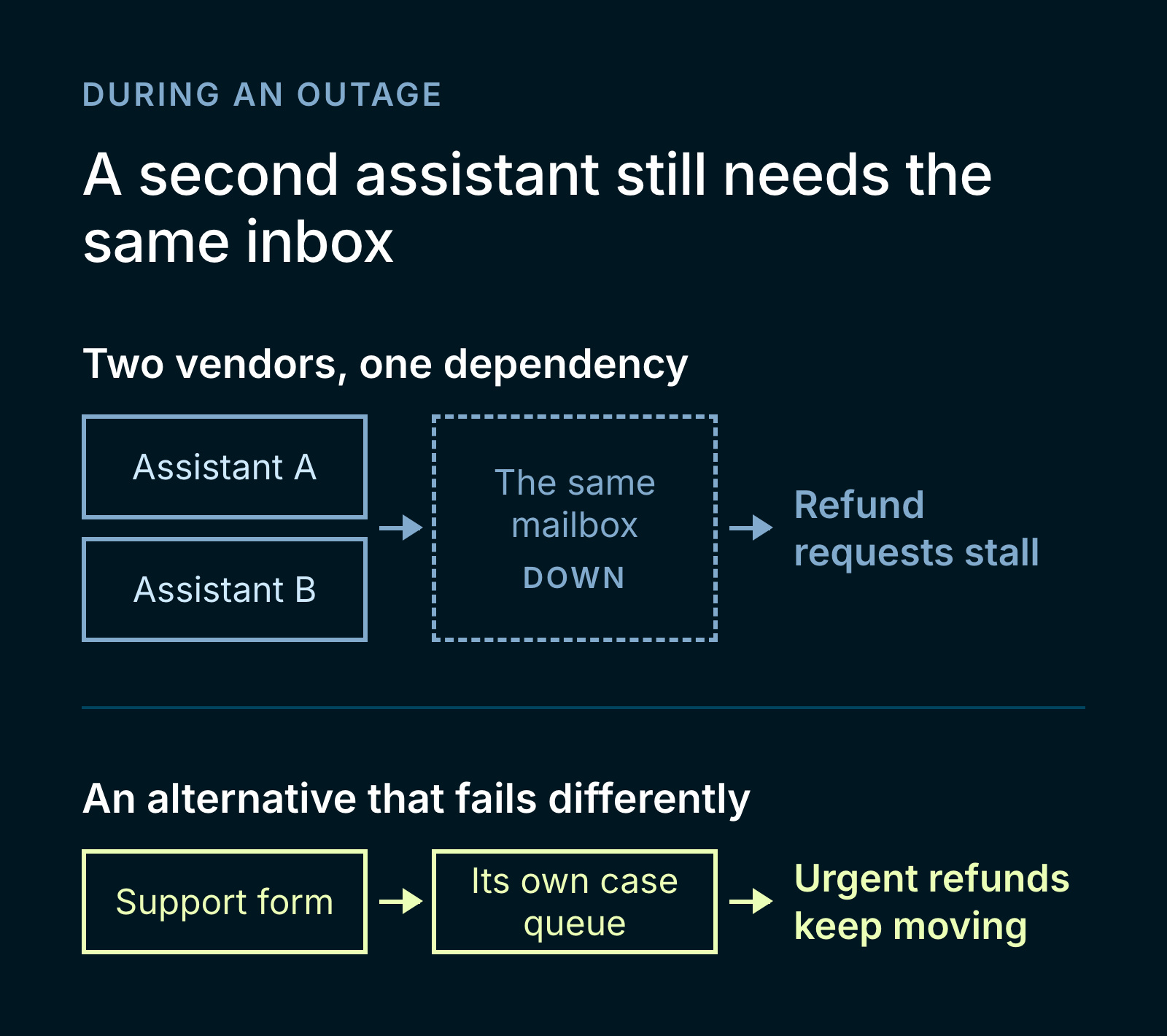
The fallback may handle fewer cases and take longer. It still protects the part of the service the business has decided cannot wait. Customers also need to know where to go: put the alternative on a help page or status page they can reach without waiting for an email from the system that’s down.
Choose an alternative that fails differently
If a model is unavailable, another approved model may be enough. If the data it needs is unavailable, another model can produce text but cannot recover the missing facts. If the problem is getting an approval, a manual route can help only if the approver can be reached and still has the information needed to decide.
The best alternative may be simpler than the primary system. A phone line, a small case queue or a human working from a short, approved set of records can cover essential work without recreating the whole stack. NIST’s contingency-planning guidance includes manual processing as a short-term option. NIST contingency planning guidance
Check what sits behind each option. A help form that sends to Outlook is not an alternative to Outlook. A backup tool that requires the same unavailable login is not an alternative to that login. And a read-only copy last updated yesterday may help a team identify open cases, but it should not be used to confirm that a payment went through this morning.
The question is not whether the backup looks different. It is whether it still works when the primary route does not.
Put the alternative to work before you need it
A fallback you have never used is still an assumption. Accounts expire. Staff forget where to go. A supplier that handled a test request may not be ready for the entire queue. The incident instructions may be in the very workspace no one can open.
Give the alternative a small, regular job. Let the support team use the secondary intake path for a defined category of requests. Exercise the backup approval route on a low-risk case. In a drill, make the primary route unavailable and follow one request through to a confirmed outcome. Google’s site reliability team documented how regularly used backup communications kept responders connected during an internal outage, and how some alternate access tools still needed more practice. Google SRE: Emergency Response
If the alternative is another supplier, find out what it has actually agreed to provide. A signed contract is little help if onboarding takes a week, the second service cannot use your data yet, or spare capacity is offered only when available. You may not need to pay for a full duplicate system, but you do need to know how quickly the alternative can take over and what it can handle.
Not every process warrants a live backup. A weekly report may be able to wait until tomorrow; a customer who cannot access a service they’ve paid for may not. Decide how long each important workflow can wait, how much demand the alternative can absorb and who can activate it. Spend on continuity where delay actually hurts.
Plan the return to normal
An outage can leave the business with two records of the same work. A customer emails first, then uses the backup form. The original message arrives late. A refund was submitted just before the outage, but the confirmation never reached the support team. Retrying because a confirmation is missing can repeat an action that already happened. AWS Builders’ Library: Making retries safe
The alternative should record enough to bring the two routes back together: which case and order were involved, what the team attempted and what was confirmed. Before clearing the backlog, the team checks uncertain refunds against the payment record and matches duplicate requests. An action with an unknown outcome stays unresolved until someone verifies it; it does not get a second attempt simply because the systems are back.
A useful drill tests that return as well as the switch. Can the business account for every urgent request and close the queue without refunding or notifying the same customer twice?
Buy the ability to keep working
At BraidNest, we’d start with one customer promise the company cannot afford to break. Follow it from intake to completion, remove one dependency in a drill and see where work stops. Then build the smallest alternative that gets the team past that point without weakening the controls that make the work safe.
Sometimes that means a second vendor. Sometimes it means giving staff another way to receive a request or a simpler way to make a decision. Either is worth more than a second subscription that goes quiet for the same reason as the first.