In brief A full rebuild is rarely necessary. Review critical dependencies and the boundaries for access, failure, recovery, and deployment, then replace systems that can no longer meet security and recovery requirements.
The digital economy has recently offered several versions of the same unsettling experience.
A cloud service becomes unavailable. A configuration change travels farther than intended. A physical failure disables systems that were expected to survive it. Another widely used product discloses a serious vulnerability. Another security report describes attackers using AI to accelerate reconnaissance or exploit development.
The incidents are different, but they produce the same question:
Are the systems beneath modern business still fit for the world they now operate in?
In February 2026, a software change at Cloudflare unintentionally withdrew approximately 1,100 customer IP prefixes, leaving affected services unreachable. The incident lasted more than six hours. Cloudflare stated explicitly that it was not a cyberattack; the damage came from an internal change with an unexpectedly large reach. Cloudflare: February 2026 outage
In September, a planned Azure deployment cleared internal caches and generated roughly twenty times the normal traffic to a backend service. Connection capacity was exhausted, automated health checks began restarting service instances, and several Azure AI services experienced failures for almost six hours. Microsoft Azure post-incident review
The following month, an electrical disruption affected one Google Cloud availability zone in London. Backup generators did not assume the load as intended, and the resulting failure propagated beyond the affected zone through control-plane dependencies, capacity constraints and failover traffic. Some services remained disrupted for more than six hours. Google Cloud incident review
None of these incidents was an AI-powered breach.
That distinction matters. Availability failures and hostile intrusions should not be collapsed into a single explanation.
But they do expose a shared architectural problem.
Too many critical systems allow one fault, dependency or trusted process to affect far more of the business than it should.
The number of weaknesses is still increasing
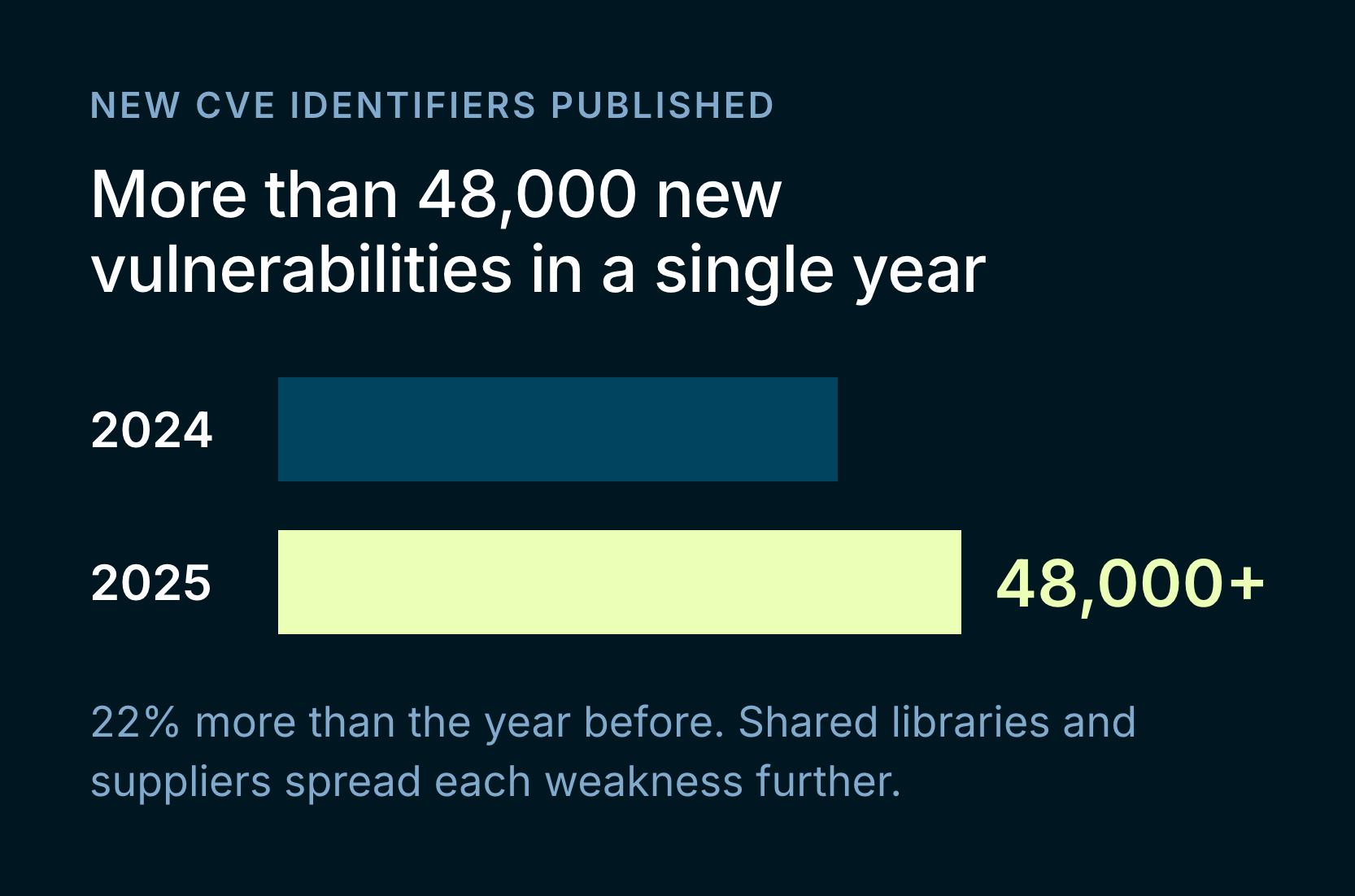
The vulnerability picture adds another layer of pressure. ENISA reported that more than 48,000 new CVE identifiers were published during 2025, an increase of 22% from the previous year. It also warned that dependencies were expanding the attack surface, particularly through third-party and supply-chain relationships. ENISA Threat Landscape 2026
A higher disclosure count does not automatically mean software quality is declining.
More software exists. More researchers are looking for weaknesses. Disclosure processes have improved, and products now contain larger dependency trees. A vulnerability in a widely used library may therefore appear across thousands of applications without having been written independently into each one.
The important development is not simply the total number.
It is the combination of volume, connectivity and speed.
A company may operate hundreds of applications, cloud resources, plugins, APIs, devices and open-source packages. It may also depend on identity providers, content-delivery networks, payment processors and model platforms that sit outside its direct control.
A weakness no longer needs to begin inside the company to become the company’s problem.
The expanding supply chain has made infrastructure easier to assemble. It has also made responsibility harder to see.
AI changes the time available to respond
AI does not need to invent an entirely new category of attack to change cybersecurity.
It only needs to make existing work faster.
The UK National Cyber Security Centre expects AI to increase the speed, scale and efficiency of reconnaissance, social engineering, vulnerability discovery and exploit development. Its assessment is that AI’s most immediate effect will be to accelerate established attack methods rather than replace them with wholly autonomous operations. NCSC Annual Review 2026
There is already evidence of that transition.
Google’s Threat Intelligence Group reported identifying a threat actor using a zero-day exploit that it believed had been developed with AI. Anthropic has described malicious operators using agent swarms to divide reconnaissance and post-exploitation tasks among multiple AI agents, while maintaining persistent records of targets, credentials and campaign progress. Google Threat Intelligence · Anthropic threat intelligence report
The practical consequence is a shrinking interval between discovery and exploitation.
An organization may previously have assumed that a newly disclosed weakness would take time to understand, weaponize and apply at scale. That assumption becomes less reliable when models can inspect code, generate tests, adapt existing exploits and scan large numbers of potential targets.
The same capability is available to defenders. AI can help discover vulnerabilities, prioritize patches and identify suspicious behaviour.
But the benefits will not be distributed evenly.
Organizations with accurate asset records, controlled deployment processes and mature monitoring can apply defensive automation effectively. Those with unsupported systems, unknown dependencies and slow approval chains may simply be attacked faster than they can respond.
AI is not creating every weakness. It is reducing the protection previously provided by obscurity, complexity and attacker effort.
A clean rewrite is not a clean slate
Against this background, rebuilding everything can sound rational.
Old software accumulated technical debt under assumptions that no longer hold. Many systems were designed when employees worked inside a corporate network, software updates arrived occasionally and most applications did not communicate continuously with external platforms.
Starting again appears to offer an opportunity to introduce modern authentication, clearer architecture and security by design.
Sometimes that is the correct decision.
But a rewrite does not eliminate risk. It exchanges one category of risk for another.
New systems contain new defects. Migrations create temporary connections between old and new environments. Business rules embedded over many years may be misunderstood or omitted. Fresh applications still depend on operating systems, libraries, identity services, clouds and third-party APIs.
A system does not become secure because it is cloud-native, recently written or connected to AI.
A twenty-year-old service that is supported, isolated, monitored and narrowly authorized may present less risk than a new agent with broad access to company data and production systems.
The relevant distinction is not old against new.
It is controllable against uncontrollable.
Some systems do need to be replaced
There is nevertheless a point at which continuing to preserve a system becomes the greater risk.
Replacement should be considered when a critical platform:
- Can no longer receive security updates.
- Cannot be patched within an acceptable period.
- Depends on credentials shared across users or services.
- Cannot produce sufficient logs to explain what occurred.
- Cannot be isolated from the wider environment.
- Contains dependencies the organization can no longer identify or maintain.
- Cannot be restored reliably from a known-good state.
- Requires permanent exceptions to ordinary security controls.
- Would allow one compromised component to expose a disproportionate part of the business.
These are not cosmetic shortcomings. They limit the organization’s ability to detect, contain and recover from an attack.
Unsupported systems are particularly difficult to defend in an environment where vulnerability discovery is accelerating. If a product cannot be updated, every new discovery increases the amount of compensating protection the organization must build around it.
Eventually, the surrounding controls become more complicated and expensive than replacing the system itself.
The mistake is waiting until the system fails before making that calculation.
Rebuild the boundaries before rebuilding the applications
Most organizations do not need to discard their entire technology estate.
They need to reconsider the boundaries that determine how far a failure can travel.
A resilient architecture assumes that components will fail, credentials will be exposed and trusted services will occasionally behave in unexpected ways. Its purpose is not to make those events impossible. It is to prevent them from becoming enterprise-wide crises.
That requires several kinds of redesign.
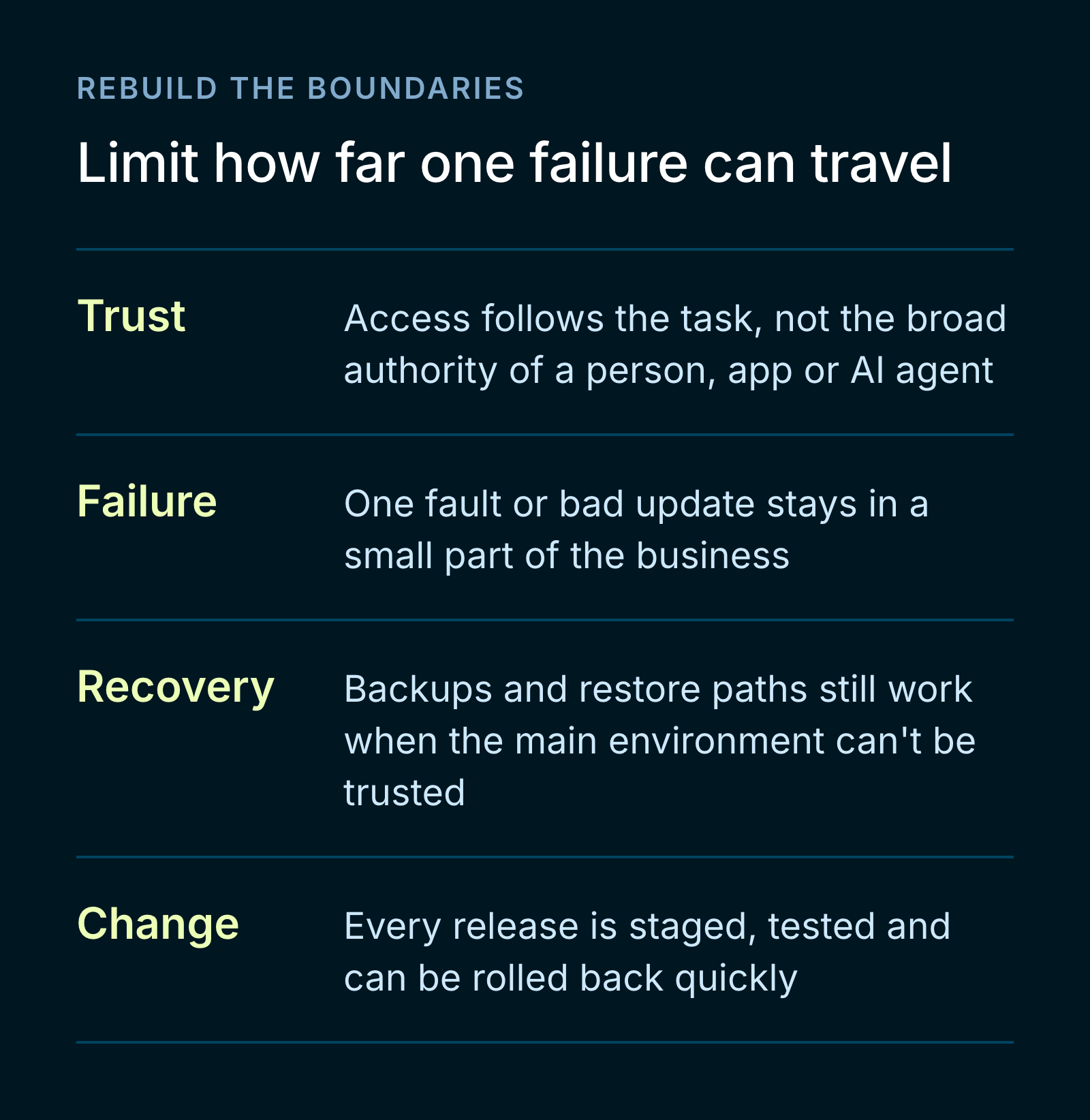
Rebuild the trust boundary
Access should follow the task being performed, not the broad authority of the employee, application or agent requesting it.
Services should have distinct identities. Credentials should be short-lived where possible. Permissions should be specific, reviewable and revocable.
AI agents require particular care because they can translate access into action at machine speed. Connecting an agent to internal systems using a highly privileged employee account allows the agent to inherit authority that was never designed for autonomous use.
The question is not merely whether the model can be trusted.
It is what the system will still prevent if the model, prompt, plugin or account is compromised.
Rebuild the failure boundary
Critical services should not depend unnecessarily on the same control plane, administrator account, network route or deployment mechanism.
Segmentation is valuable because it limits both hostile movement and accidental propagation. A failed update should affect the smallest possible portion of the environment. A compromised support tool should not provide a path into finance, infrastructure and customer data.
Cloudflare’s response to its February outage included circuit-breaker controls intended to stop unusually broad routing changes before they could produce the same blast radius again.
That principle applies beyond network infrastructure.
A resilient system is not one in which nothing fails. It is one in which failure remains proportionate.
Rebuild the recovery boundary
Backups are insufficient if they can be deleted through the same credentials used to compromise production.
Monitoring is insufficient if it depends on the platform it is monitoring.
A secondary environment is insufficient if it relies on the same identity provider, network path or administrative control plane as the primary one.
Recovery capabilities should remain available when the normal environment cannot be trusted. That may require immutable copies, independent credentials, known-good configurations and a degraded operating mode that preserves the company’s most important work.
The recovery process must also be tested.
An untested plan records an intention. A rehearsal reveals whether the organization can actually restore data, reissue access, reconnect dependencies and make decisions under pressure.
Rebuild the change boundary
Many damaging outages begin with legitimate changes.
The answer is not to stop changing systems. Delayed updates create their own vulnerabilities.
The answer is to make change safer through staged deployment, automated testing, limited exposure, rapid rollback and circuit breakers that recognize when a release is behaving differently from expectation.
The same controls help with emergency patching.
Organizations will increasingly need to apply security updates quickly without turning every patch into an availability gamble. That requires deployment systems capable of testing, containing and reversing change—not simply a policy instructing teams to move faster.
The unit of modernization is the failure boundary
Technology programmes are often organized around applications.
Replace the customer platform. Move the database. Modernize the website. Introduce an AI assistant.
Risk rarely respects those project boundaries.
A customer workflow may cross identity, CRM, payments, messaging, storage and model services. Replacing one application without understanding those relationships may move the weakness rather than remove it.
A more useful modernization question is:
Where can one failure, compromise or unavailable dependency stop the business from producing an essential outcome?
That question may lead to a full replacement.
It may instead lead to isolating a legacy system, removing internet exposure, changing its permissions, introducing an independent recovery path or reducing the amount of data it holds.
The objective is not maximum modernization.
It is the greatest reduction in consequential risk for the investment being made.
NIST defines cyber resilience around the ability to anticipate, withstand, recover from and adapt to adverse conditions and compromise. That is a broader standard than prevention alone. NIST: Developing Cyber-Resilient Systems
Security is becoming an operating capability
The growing volume of vulnerabilities cannot be managed as a periodic compliance exercise.
Infrastructure must be examined continuously enough to identify what is exposed, what has changed and which weaknesses could materially affect the business.
That does not mean treating every published vulnerability as an emergency.
Prioritization should consider whether the affected component exists in the environment, whether it is reachable, whether exploitation is practical, what authority it possesses and what would happen if it were compromised.
This also requires ownership.
Someone must be responsible for deciding when a system is patched, isolated, restricted or retired. Someone must know which business process will be affected and how the organization will continue operating while the change is made.
Without that connection, vulnerability management becomes a growing list of technical findings detached from commercial decisions.
The foundations still matter
The arrival of AI can make cybersecurity appear to require an entirely new doctrine.
The NCSC’s current guidance reaches a more restrained conclusion: AI is making familiar defensive practices more urgent. Organizations still need to understand their technology, keep it updated, control access, maintain backups and prepare for incidents. AI changes the economics and speed of attack, but it does not make those foundations obsolete. NCSC: Embedding cybersecurity into everything
What does need to change is the tolerance for unresolved weakness.
A system that takes months to patch, cannot explain its dependencies and cannot be restored independently may have survived in a slower threat environment. It becomes harder to justify when attackers can examine and target weaknesses with increasing automation.
At BraidNest, we do not begin with the assumption that an organization’s infrastructure should be replaced.
We begin by determining what is actually there, how critical workflows depend on it, where access is concentrated, which vulnerabilities are materially exploitable and how far a failure could travel.
That may lead to a ground-up rebuild of a strategically important system. It may lead to a focused infrastructure audit, better isolation, narrower permissions, safer deployment or a recovery path that does not depend on the environment it is meant to restore.
The right answer will rarely be to rebuild everything.
It will be to rebuild the parts of the architecture that still assume failures remain local, attackers move slowly and trusted systems always behave as intended.
Those assumptions no longer belong in the foundations of an AI-connected business.
Developments reviewed through November 17, 2026. This article is strategic commentary and does not constitute cybersecurity or legal advice.