Much of our recent thinking has focused on what happens above the infrastructure layer: how businesses can use AI to create capacity, redesign services, and build systems whose ongoing costs remain deliberate rather than incidental.
In this perspective, we would like to take a step back from the services that run on AI and look instead at the chips that run it.
The same principle applies further down the stack. The value of a technology cannot be separated from the economics of keeping it useful over time.
The valuations attached to AI chip companies reflect more than continued enthusiasm for artificial intelligence. They carry an expectation that customers will keep purchasing increasingly powerful infrastructure—and that this relentless upgrade cycle will not leave too much stranded value behind.
That is a more demanding assumption than it first appears.
An AI accelerator may function for six years. It may remain useful for inference, fine-tuning, research, or smaller workloads long after its introduction.
But functioning is not the same as remaining competitive.
When a new generation offers materially better performance per watt, lower cost per token, greater memory capacity, or faster training, the previous generation can lose its position at the frontier well before it reaches the end of its physical life.
The central valuation question is therefore not whether today’s chips will still work several years from now. It is whether they can continue producing acceptable economic returns after something substantially better arrives.
One asset, three different lifespans
AI hardware has at least three relevant lives:
Physical life: How long the equipment can operate reliably.
Accounting life: The period over which its cost is depreciated.
Competitive life: How long it remains attractive for the most valuable workloads.
These periods do not necessarily align.
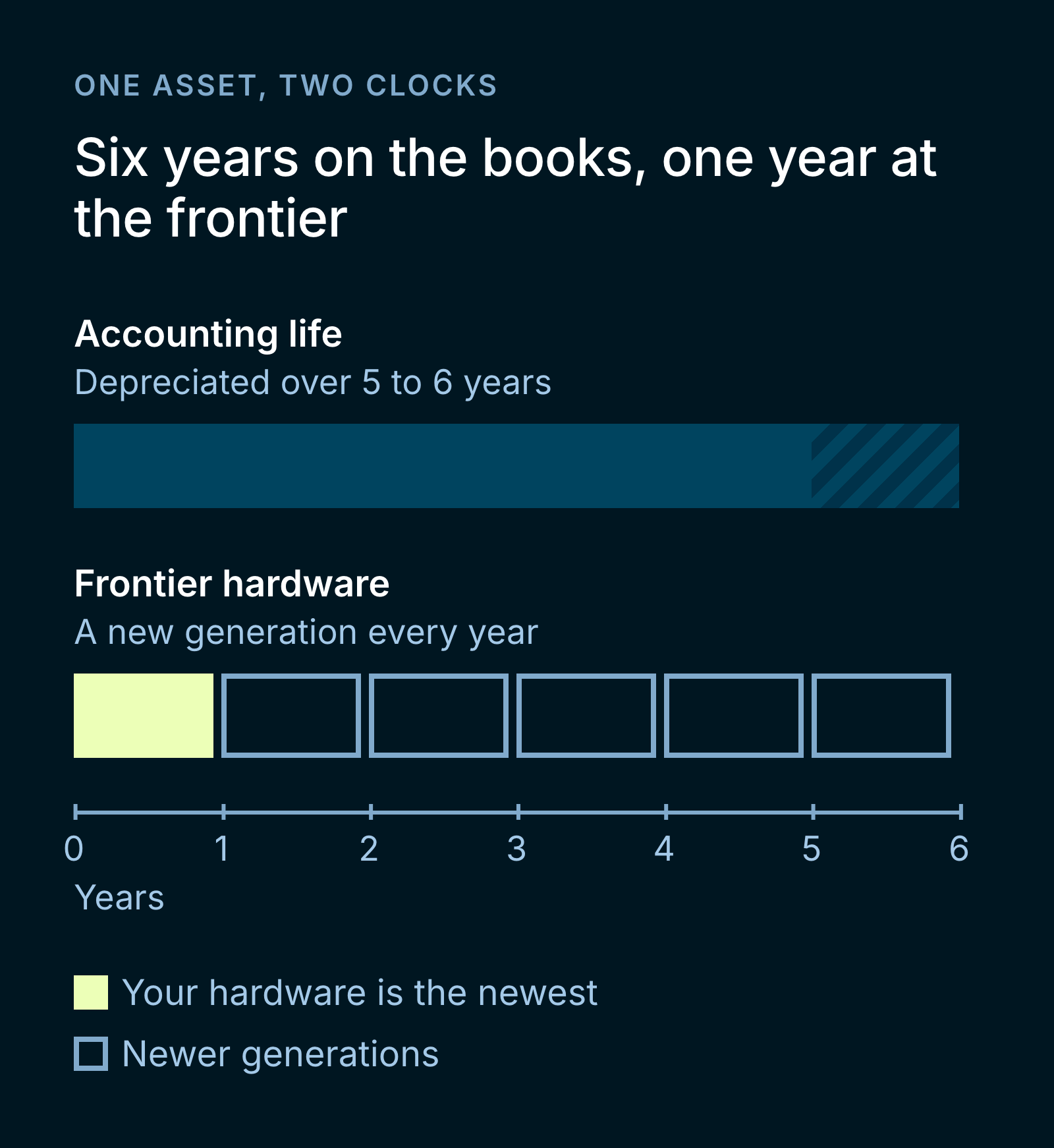
Alphabet depreciates servers and network equipment over approximately six years. Microsoft previously extended the estimated life of those assets from four to six years. Meta extended certain server and network assets to 5.5 years. CoreWeave assigns a six-year useful life to technology equipment used in its data centers.
These classifications are broader than AI accelerators alone, but they demonstrate how long major operators expect infrastructure to produce economic benefit.
Sources Alphabet 2025 10-K • Microsoft 2024 10-K • Meta 2024 10-K • CoreWeave prospectus
The financial effect is consequential. Extending an asset’s estimated life spreads its cost across more reporting periods, reducing annual depreciation expense.
But the assumptions can move in the opposite direction.
Amazon shortened the useful life of a subset of its servers and networking equipment from six years to five, citing the increased pace of development in AI and machine learning. It also recorded approximately $920 million in accelerated depreciation and related charges after deciding to retire certain equipment early.
Sources Amazon 2024 10-K
That is the tension in plain sight: assets may be accounted for as multi-year infrastructure while the technology defining their highest-value use is advancing much faster.
The frontier is now on an annual schedule
Nvidia states that it is pursuing a one-year product cadence for its data-center architectures. Its own risk disclosures acknowledge that customers may delay purchases ahead of transitions and that demand for current architectures can decline when the next generation is anticipated.
Sources Nvidia FY2026 10-K
The company’s performance claims illustrate why.
Nvidia says its Rubin platform can train certain large mixture-of-experts models using one-quarter as many GPUs as Blackwell and deliver up to ten times the inference throughput per watt at one-tenth the cost per token.
These are vendor estimates and will vary by workload, software maturity, utilization, and system configuration. But even a fraction of that improvement can materially change purchasing decisions in a power-constrained data center.
Sources Nvidia Rubin announcement
If the newest rack can produce significantly more tokens from the same megawatt, the older rack does not need to fail before it becomes less desirable.
Its competitive life may have ended even while its physical life has years remaining.
This does not mean every operator will replace an entire fleet annually. Data centers take time to build, new platforms take time to qualify, and the newest systems may require different cooling, networking, and power infrastructure.
A more realistic pattern is annual replenishment followed by a cascade of workloads. Frontier training moves to the newest systems. Previous generations move into inference, fine-tuning, batch processing, development, or lower-priced cloud capacity.
The frontier refreshes annually. The fleet turns over gradually.
Research makes the picture more complicated
Peer-reviewed evidence supports both sides of the argument.
Research presented at NeurIPS 2024 found that the compute required to reach a fixed language-model performance threshold fell by approximately half every eight months between 2012 and 2023 because of algorithmic progress. Yet the researchers also found that growth in physical compute made an even larger contribution to overall performance gains during the period.
Sources Ho et al., NeurIPS 2024
This creates two opposing effects.
Better algorithms allow more useful work to be extracted from existing hardware. At the same time, developers use those gains to pursue more ambitious models, larger datasets, longer contexts, and more computationally intensive reasoning.
Efficiency does not necessarily reduce demand. It can expand what becomes economically possible.
The influential Chinchilla research reached a related conclusion. A 70-billion-parameter model trained on substantially more data outperformed much larger models using the same training-compute budget, while also requiring less compute for subsequent inference.
Sources Hoffmann et al., NeurIPS 2022
Hardware value, therefore, cannot be judged by headline specifications alone. Model architecture, training strategy, software optimization, memory, networking, utilization, and workload selection all affect how productive a system will be.
The peer-reviewed MLPerf work similarly treats machine-learning performance as the outcome of a complete hardware-and-software system, rather than the chip in isolation.
Sources MLPerf Training, MLSys 2020 • MLPerf Inference, ISCA 2020
Even the case for replacement is workload-dependent.
A 2026 ICDE study examined the environmental break-even point for replacing data-center GPUs. Depending on the hardware, workload, utilization, and electricity mix, some replacements broke even within months, others required more than three years, and some never reached an ecological break-even point.
The researchers found that upgrading from an H100 to a B200 could take more than three years to break even in certain matrix-multiplication scenarios.
Sources Baeuerle et al., ICDE 2026
The study evaluates environmental rather than financial returns, but its operating lesson is important: newer is not automatically better in every deployed workload.
The second life carries the thesis
The strongest argument against rapid economic obsolescence is that older accelerators can be reassigned.
CoreWeave explicitly describes this model in its prospectus. Initial customer contracts generally run for two to five years. Afterward, it seeks to place the underlying infrastructure into another committed contract or an on-demand pool.
The company reports successfully moving former-generation A100 GPUs into new contracts while maintaining high utilization.
Sources CoreWeave prospectus
Peer-reviewed systems research shows how that reuse can become more efficient.
HeteGen combines CPU and GPU resources to improve inference on constrained systems. ThunderServe coordinates different GPU types across heterogeneous cloud environments. Zorse applies heterogeneous clusters to model training, specifically allowing GPUs from different generations to contribute without the slowest devices necessarily determining the performance of the entire system.
Sources HeteGen, MLSys 2024 • ThunderServe, MLSys 2025 • Zorse, MLSys 2026
Old chips do not suddenly become useless. They become useful to a different customer, for a different workload, at a different price.
That distinction is where much of the investment risk sits.
A shorter cycle does not affect everyone equally
For chip designers, rapid replacement can be an advantage. If customers purchase each new generation while continuing to use previous ones, the installed base expands and replacement demand compounds.
For hyperscalers, the risk may be manageable because they control large, varied pools of workloads. They can move capacity from frontier training into internal inference, search, advertising, productivity applications, or customer cloud services.
Specialized GPU clouds face a more direct challenge. Their returns depend on utilization, contract pricing, financing costs, power availability, and the residual earning power of specific GPU generations. If an older fleet cannot be re-contracted profitably, a six-year accounting life will not create a six-year economic life.
Enterprises purchasing dedicated systems may be more exposed still. They often have fewer workloads across which to redeploy the hardware and less ability to optimize mixed-generation fleets.
The same annual product cadence can therefore create recurring revenue for the chipmaker, a manageable capacity cascade for the hyperscaler, and residual-value risk for the infrastructure owner.
What valuations are really assuming
The market does not need every chip to remain state of the art for six years.
It does need several other things to remain true:
- Total AI demand must grow faster than the cost of producing a unit of useful compute falls.
- Previous-generation hardware must retain enough utilization and pricing power to cover its energy, financing, and operating costs.
- New applications must emerge behind the frontier, creating a staircase of workloads for older systems.
- Software must continue making heterogeneous fleets easier to operate.
- Depreciation changes and early retirements must remain manageable relative to revenue growth.
- Chip suppliers must preserve enough technical and ecosystem advantage to capture the next replacement cycle.
If those conditions hold, annual technological obsolescence can strengthen the chip suppliers’ economics. Every new generation becomes another reason for customers to spend.
If they fail, the same cadence can expose a growing inventory of assets that still function but no longer earn what their owners expected.
That is the risk hidden inside the AI infrastructure boom.
Watch the staircase, not only the frontier
The most important indicators may not be benchmark leadership or the number of GPUs deployed.
They may be:
- Rental pricing and utilization by GPU generation.
- Revenue generated per megawatt of deployed capacity.
- The speed at which previous-generation hardware is re-contracted.
- Changes in depreciation lives, impairments, and accelerated retirement charges.
- Capital expenditure relative to identifiable AI revenue and free cash flow.
- The difference between performance gains promised by a new platform and those achieved in production.
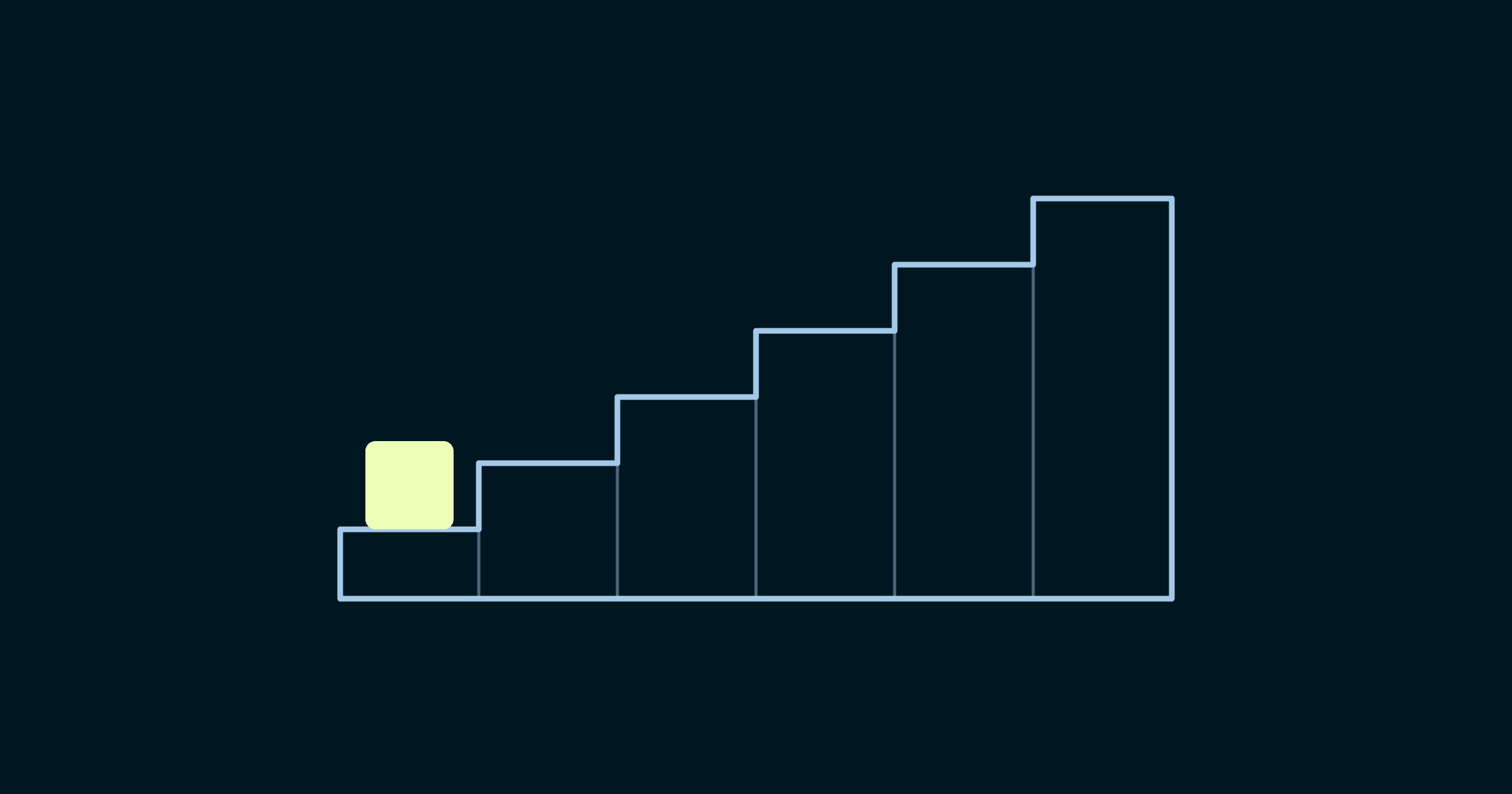
A healthy market will form a staircase. The newest systems will command frontier workloads and premium pricing. Earlier generations will step down into less demanding but still profitable uses.
An unhealthy one will form a cliff.
The chips may last six years. The frontier may last twelve months. The durability of today’s valuations depends on what happens in between.
Our broader position at BraidNest is that technology should be evaluated across its full operating life—not only at the moment of adoption. That applies whether a business is routing work between AI models, redesigning a service around automation, or investing billions in the infrastructure beneath it.
Cost, utility, and the pace of renewal have to be considered together.
That is often where the difference lies between adopting powerful technology and building durable value from it.
Research and filings reviewed through August 13, 2026. This article is strategic commentary, not investment advice.